Pearson+ LogoPearson+ Logo
Ch. 10 - Photosynthesis
Campbell - Campbell Biology 12th Edition
Urry12th EditionCampbell BiologyISBN: 9785794169850Not the one you use?Change textbook
Chapter 10, Problem 5

Which of the following occurs during the Calvin cycle?
a. Carbon fixation
b. Reduction of NADP+
c. Release of oxygen
d. Generation of CO₂

Verified step by step guidance
1
Understand the Calvin cycle: The Calvin cycle is a series of biochemical reactions that occur in the stroma of chloroplasts in photosynthetic organisms. It is part of the light-independent reactions of photosynthesis.
Identify the main processes of the Calvin cycle: The Calvin cycle involves three main stages: carbon fixation, reduction phase, and regeneration of ribulose bisphosphate (RuBP).
Carbon fixation: During this stage, carbon dioxide ( CO 2 ) is fixed into an organic molecule. This is the first step of the Calvin cycle.
Reduction phase: In this phase, ATP and NADPH produced during the light-dependent reactions are used to convert 3-phosphoglycerate into glyceraldehyde-3-phosphate (G3P). This involves the reduction of 3-phosphoglycerate.
Regeneration of RuBP: The final stage involves the regeneration of RuBP, allowing the cycle to continue. This does not involve the release of oxygen or generation of CO 2 .

Verified video answer for a similar problem:

This video solution was recommended by our tutors as helpful for the problem above.
Video duration:
5m
Was this helpful?

Key Concepts

Here are the essential concepts you must grasp in order to answer the question correctly.

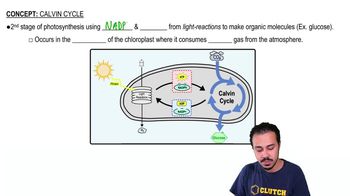
Calvin Cycle

The Calvin Cycle is a series of biochemical reactions that occur in the stroma of chloroplasts in photosynthetic organisms. It is part of the light-independent reactions of photosynthesis, where atmospheric carbon dioxide is fixed into organic molecules, ultimately producing glucose. The cycle involves three main stages: carbon fixation, reduction, and regeneration of ribulose bisphosphate.
Recommended video:

Carbon Fixation

Carbon fixation is the initial step of the Calvin Cycle, where carbon dioxide is incorporated into an organic molecule. This process is catalyzed by the enzyme RuBisCO, which combines CO2 with ribulose bisphosphate (RuBP) to form 3-phosphoglycerate (3-PGA). This step is crucial for converting inorganic carbon into a form that can be used by the plant to build sugars.
Recommended video:

Reduction Phase

During the reduction phase of the Calvin Cycle, ATP and NADPH produced in the light-dependent reactions are used to convert 3-phosphoglycerate into glyceraldehyde-3-phosphate (G3P). This involves the reduction of 3-PGA, where NADPH donates electrons, transforming it into G3P, a sugar molecule that can be used to form glucose and other carbohydrates.
Recommended video:
Guided course
03:21
Phases of Mitosis
Related Practice