Pearson+ LogoPearson+ Logo
Ch. 14 - Mendel and the Gene Idea
Campbell - Campbell Biology 12th Edition
Urry12th EditionCampbell BiologyISBN: 9785794169850Not the one you use?Change textbook
Chapter 14, Problem 1

A pea plant heterozygous for inflated pods (Ii) is crossed with a plant homozygous for constricted pods (ii). Draw a Punnett square for this cross to predict genotypic and phenotypic ratios. Assume that pollen comes from the ii plant.

Verified step by step guidance
1
Step 1: Understand the genetic makeup of the parents. The heterozygous pea plant has the genotype Ii, meaning it has one dominant allele (I) for inflated pods and one recessive allele (i) for constricted pods. The homozygous pea plant has the genotype ii, meaning it has two recessive alleles for constricted pods.
Step 2: Set up the Punnett square. A Punnett square is a grid used to predict the genotypes of offspring. Write the alleles of the heterozygous parent (Ii) along the top of the square, and the alleles of the homozygous parent (ii) along the side of the square. This will create a 2x2 grid.
Step 3: Fill in the Punnett square. Combine the alleles from the top and side of the grid to determine the possible genotypes of the offspring. For example, the top row of the grid will combine the I allele from the heterozygous parent with the i allele from the homozygous parent, and the bottom row will combine the i allele from the heterozygous parent with the i allele from the homozygous parent.
Step 4: Analyze the genotypic ratios. Count the number of each genotype in the Punnett square. For this cross, you will have two Ii offspring (heterozygous for inflated pods) and two ii offspring (homozygous for constricted pods). The genotypic ratio is therefore 2 Ii : 2 ii.
Step 5: Determine the phenotypic ratios. Since the dominant allele (I) results in inflated pods, the heterozygous offspring (Ii) will have inflated pods, while the homozygous recessive offspring (ii) will have constricted pods. The phenotypic ratio is therefore 2 inflated pods : 2 constricted pods.

Verified video answer for a similar problem:

This video solution was recommended by our tutors as helpful for the problem above.
Video duration:
1m
Was this helpful?

Key Concepts

Here are the essential concepts you must grasp in order to answer the question correctly.

Punnett Square

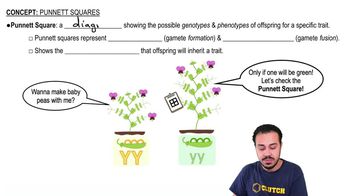
A Punnett square is a diagram used to predict the genotypic and phenotypic outcomes of a genetic cross. It organizes the possible combinations of alleles from each parent, allowing for a visual representation of inheritance patterns. In this case, it will help determine the ratios of offspring genotypes and phenotypes resulting from the cross between a heterozygous and a homozygous plant.
Recommended video:
Guided course
01:37
Punnett Squares

Genotype and Phenotype

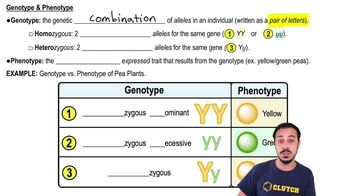
Genotype refers to the genetic makeup of an organism, specifically the alleles it possesses for a particular trait. Phenotype, on the other hand, is the observable expression of that genotype, influenced by both genetic and environmental factors. Understanding the difference is crucial for interpreting the results of the Punnett square in terms of both genetic ratios and physical traits.
Recommended video:
Guided course
06:36
Genotype & Phenotype

Mendelian Inheritance

Mendelian inheritance is the set of principles that describe how traits are passed from parents to offspring through alleles. It includes concepts such as dominance, where one allele can mask the expression of another, and segregation, which states that allele pairs separate during gamete formation. This framework is essential for predicting the outcomes of genetic crosses, such as the one described in the question.
Recommended video:
Guided course
02:27
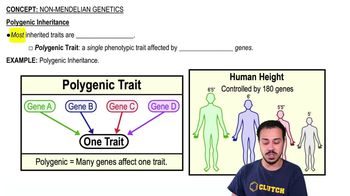
Polygenic Inheritance