Pearson+ LogoPearson+ Logo
Ch. 14 - Mendel and the Gene Idea
Campbell - Campbell Biology 12th Edition
Urry12th EditionCampbell BiologyISBN: 9785794169850Not the one you use?Change textbook
Chapter 14, Problem 4

Two pea plants heterozygous for the characters of pod color and pod shape are crossed. Draw a Punnett square to determine the phenotypic ratios of the offspring.

Verified step by step guidance
1
Identify the genotypes of the parent pea plants. Since they are heterozygous for both traits, their genotypes are RrYy, where 'R' and 'r' represent the alleles for pod color, and 'Y' and 'y' represent the alleles for pod shape.
Determine the possible gametes each parent can produce. Each parent can produce four types of gametes: RY, Ry, rY, and ry. This is because each allele for one trait can combine with each allele for the other trait.
Set up a 4x4 Punnett square. Label the rows with the gametes from one parent (RY, Ry, rY, ry) and the columns with the gametes from the other parent (RY, Ry, rY, ry).
Fill in the Punnett square by combining the alleles from the gametes at the top of each column with those at the beginning of each row. This will give you 16 possible genotypes for the offspring.
Determine the phenotypic ratios by analyzing the genotypes in the Punnett square. Count how many of each phenotype appear, considering that 'R' is dominant over 'r' and 'Y' is dominant over 'y'.

Verified video answer for a similar problem:

This video solution was recommended by our tutors as helpful for the problem above.
Video duration:
4m
Was this helpful?

Key Concepts

Here are the essential concepts you must grasp in order to answer the question correctly.

Mendelian Genetics

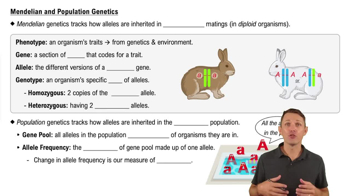
Mendelian genetics is the study of how traits are inherited through the actions of alleles, which are different forms of a gene. Gregor Mendel's principles, including the law of segregation and the law of independent assortment, explain how alleles separate and recombine during reproduction, leading to genetic variation in offspring.
Recommended video:
04:26
Mendelian and Population Genetics

Punnett Square

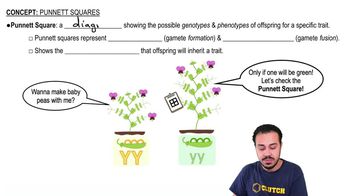
A Punnett square is a diagram used in genetics to predict the genotypes of offspring from a particular cross or breeding experiment. It allows visualization of how alleles from each parent combine, showing all possible genetic combinations and their associated probabilities, which helps in determining phenotypic ratios.
Recommended video:
Guided course
01:37
Punnett Squares

Phenotypic Ratio

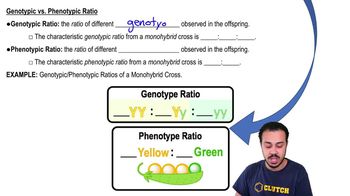
The phenotypic ratio refers to the relative number of offspring manifesting different traits or phenotypes resulting from a genetic cross. In a dihybrid cross involving two heterozygous parents, the typical phenotypic ratio is 9:3:3:1, representing the distribution of dominant and recessive traits in the offspring.
Recommended video:
Guided course
02:48
Genotypic vs. Phenotypic Ratio
Related Practice
Textbook Question

A pea plant heterozygous for inflated pods (Ii) is crossed with a plant homozygous for constricted pods (ii). Draw a Punnett square for this cross to predict genotypic and phenotypic ratios. Assume that pollen comes from the ii plant.

379
views
Textbook Question

A man with type A blood marries a woman with type B blood. Their child has type O blood. What are the genotypes of these three individuals? What genotypes, and in what frequencies, would you expect in future offspring from this marriage?

2547
views
Textbook Question

A man has six fingers on each hand and six toes on each foot. His wife and their daughter have the normal number of digits. Remember that extra digits is a dominant trait. What fraction of this couple's children would be expected to have extra digits?

3360
views
Textbook Question

Flower position, stem length, and seed shape are three characters that Mendel studied. Each is controlled by an independently assorting gene and has dominant and recessive expression as indicated in Table 14.1.


If a plant that is heterozygous for all three characters is allowed to self-fertilize, what proportion of the offspring would you expect to be each of the following? (Note: Use the rules of probability instead of a huge Punnett square.)

a. Homozygous for the three dominant traits

b. Homozygous for the three recessive traits

c. Heterozygous for all three characters

d. Homozygous for axial and tall, heterozygous for seed shape
2157
views
Textbook Question

Hemochromatosis is an inherited disease caused by a recessive allele. If a woman and her husband, who are both carriers, have three children, what is the probability of each of the following?

a. All three children are of normal phenotype

b. One or more of the three children have the disease

c. All three children have the disease

d. At least one child is phenotypically normal

1921
views
Textbook Question

The genotype of F1 individuals in a tetrahybrid cross is AaBbCcDd. Assuming independent assortment of these four genes, what are the probabilities that F2 offspring will have the following genotypes?

a. aabbccdd

b. AaBbCcDd

c. AABBCCDD

d. AaBBccDd

e. AaBBCCdd

4249
views