Pearson+ LogoPearson+ Logo
Ch. 14 - Mendel and the Gene Idea
Campbell - Campbell Biology 12th Edition
Urry12th EditionCampbell BiologyISBN: 9785794169850Not the one you use?Change textbook
Chapter 14, Problem 7

The genotype of F1 individuals in a tetrahybrid cross is AaBbCcDd. Assuming independent assortment of these four genes, what are the probabilities that F2 offspring will have the following genotypes?
a. aabbccdd
b. AaBbCcDd
c. AABBCCDD
d. AaBBccDd
e. AaBBCCdd

Verified step by step guidance
1
Understand that independent assortment means each gene pair segregates independently during gamete formation. This is based on Mendel's law of independent assortment.
For each gene pair, calculate the probability of inheriting a specific allele combination. For example, the probability of inheriting 'aa' from 'Aa' is 1/4, since each parent can contribute either 'A' or 'a'.
Apply the probability rule for independent events: multiply the probabilities of each independent event to find the overall probability of a genotype. For example, the probability of 'aabbccdd' is the product of the probabilities of 'aa', 'bb', 'cc', and 'dd'.
Repeat the calculation for each requested genotype. For instance, for 'AaBbCcDd', calculate the probability of inheriting 'Aa' (1/2), 'Bb' (1/2), 'Cc' (1/2), and 'Dd' (1/2), then multiply these probabilities.
Consider the dominance and recessiveness of alleles if needed, but in this case, focus on the probability of allele combinations rather than phenotypic expression.

Verified video answer for a similar problem:

This video solution was recommended by our tutors as helpful for the problem above.
Video duration:
1m
Was this helpful?

Key Concepts

Here are the essential concepts you must grasp in order to answer the question correctly.

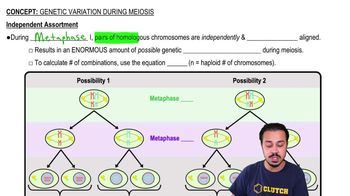
Independent Assortment

Independent assortment is a principle of Mendelian genetics stating that alleles of different genes segregate independently during gamete formation. This means the inheritance of one trait generally does not affect the inheritance of another, allowing for various combinations of alleles in offspring. In a tetrahybrid cross, each gene pair segregates independently, leading to diverse genotypic possibilities.
Recommended video:
Guided course
08:49
Independent Assortment

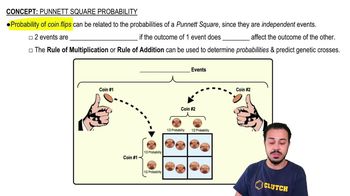
Probability in Genetics

Probability in genetics involves calculating the likelihood of specific genotypes or phenotypes appearing in offspring. This is done using the principles of Mendelian inheritance, where the probability of inheriting a particular allele from each parent is considered. For a tetrahybrid cross, probabilities are calculated by multiplying the chances of inheriting each allele independently.
Recommended video:
Guided course
03:38
Punnett Square Probability

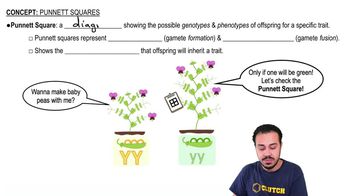
Punnett Square

A Punnett square is a diagram used to predict the genotypes of offspring from a particular genetic cross. It helps visualize how alleles from each parent combine, showing all possible genetic outcomes. In a tetrahybrid cross, a Punnett square can be complex, but it systematically illustrates the independent assortment and combination of alleles for multiple genes.
Recommended video:
Guided course
01:37
Punnett Squares
Related Practice
Textbook Question

Two pea plants heterozygous for the characters of pod color and pod shape are crossed. Draw a Punnett square to determine the phenotypic ratios of the offspring.

2649
views
Textbook Question

Flower position, stem length, and seed shape are three characters that Mendel studied. Each is controlled by an independently assorting gene and has dominant and recessive expression as indicated in Table 14.1.


If a plant that is heterozygous for all three characters is allowed to self-fertilize, what proportion of the offspring would you expect to be each of the following? (Note: Use the rules of probability instead of a huge Punnett square.)

a. Homozygous for the three dominant traits

b. Homozygous for the three recessive traits

c. Heterozygous for all three characters

d. Homozygous for axial and tall, heterozygous for seed shape

2157
views
Textbook Question

Hemochromatosis is an inherited disease caused by a recessive allele. If a woman and her husband, who are both carriers, have three children, what is the probability of each of the following?

a. All three children are of normal phenotype

b. One or more of the three children have the disease

c. All three children have the disease

d. At least one child is phenotypically normal

1921
views
Textbook Question

What is the probability that each of the following pairs of parents will produce the indicated offspring? (Assume independent assortment of all gene pairs.)

a. AABBCC×aabbcc→AaBbCc

b. AABbCc×AaBbCc→AAbbCC

c. AaBbCc×AaBbCc→AaBbCc

d. aaBbCC×AABbcc→AaBbCc

3100
views
Textbook Question

Karen and Steve each have a sibling with sickle-cell disease. Neither Karen nor Steve nor any of their parents have the disease, and none of them have been tested to see if they carry the sickle-cell allele. Based on this incomplete information, calculate the probability that if this couple has a child, the child will have sickle-cell disease.

2368
views
Textbook Question

In 1981, a stray black cat with unusual rounded, curled-back ears was adopted by a family in California. Hundreds of descendants of the cat have since been born, and cat fanciers hope to develop the curl cat into a show breed. Suppose you owned the first curl cat and wanted to develop a true-breeding variety. How would you determine whether the curl allele is dominant or recessive? How would you obtain true-breeding curl cats? How could you be sure they are true-breeding?

<IMAGE>

1165
views