Pearson+ LogoPearson+ Logo
Ch. 17 - Gene Expression: From Gene to Protein
Campbell - Campbell Biology 12th Edition
Urry12th EditionCampbell BiologyISBN: 9785794169850Not the one you use?Change textbook
Chapter 17, Problem 4

Which of the following is true of RNA processing? (A) Exons are cut out before mRNA leaves the nucleus. (B) Nucleotides are added at both ends of the RNA. (C) Ribozymes may function in the addition of a 5′ cap. (D) RNA splicing adds a poly-A tail to the mRNA.

Verified step by step guidance
1
Identify the correct statements about RNA processing, which involves modifications to the pre-mRNA transcript in eukaryotic cells.
Understand that exons are the coding regions of the RNA that remain in the sequence to be expressed, while introns are the non-coding regions that are removed during RNA splicing.
Recognize that a 5′ cap is added to the 5′ end of the RNA and a poly-A tail is added to the 3′ end, but these modifications involve specific enzymes rather than ribozymes.
Recall that RNA splicing involves the removal of introns and the joining of exons, and does not add a poly-A tail to the mRNA.
Evaluate each option based on the known processes of RNA processing: splicing, 5′ capping, and poly-A tail addition.

Verified video answer for a similar problem:

This video solution was recommended by our tutors as helpful for the problem above.
Video duration:
1m
Was this helpful?

Key Concepts

Here are the essential concepts you must grasp in order to answer the question correctly.

RNA Processing

RNA processing refers to the modifications that pre-mRNA undergoes before it becomes mature mRNA. This includes the removal of non-coding sequences called introns and the joining together of coding sequences known as exons. Additionally, RNA processing involves the addition of a 5' cap and a poly-A tail, which are crucial for mRNA stability and translation.
Recommended video:
Guided course
04:19
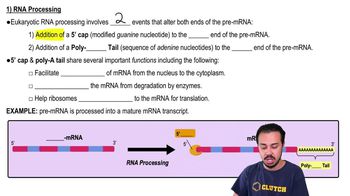
1) RNA Processing

Exons and Introns

Exons are the coding regions of a gene that are retained in the final mRNA product, while introns are non-coding regions that are removed during RNA splicing. Understanding the distinction between exons and introns is essential for grasping how mRNA is prepared for translation, as only exons contribute to the protein-coding sequence.
Recommended video:
Guided course
08:44
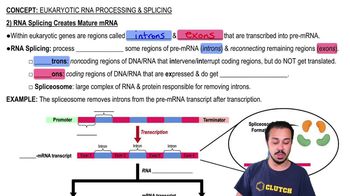
2) RNA Splicing Creates Mature mRNA

5' Cap and Poly-A Tail

The 5' cap is a modified guanine nucleotide added to the beginning of the mRNA transcript, which protects the mRNA from degradation and assists in ribosome binding during translation. The poly-A tail, a sequence of adenine nucleotides added to the 3' end, also enhances mRNA stability and regulates its translation efficiency. Both modifications are critical for the proper functioning of mRNA in protein synthesis.
Recommended video:
Guided course
04:19
1) RNA Processing
Related Practice
Textbook Question

In eukaryotic cells, transcription cannot begin until

a. The two DNA strands have completely separated and exposed the promoter.

b. Several transcription factors have bound to the promoter.

c. The 5′ caps are removed from the mRNA.

d. The DNA introns are removed from the template.

2926
views
1
rank
Textbook Question

Which of the following is true of a codon?

a. It never codes for the same amino acid as another codon.

b. It can code for more than one amino acid.

c. It can be either in DNA or in RNA

d. It is the basic unit of protein structure

2887
views
Textbook Question

The anticodon of a particular tRNA molecule is

a. Complementary to the corresponding mRNA codon

b. Complementary to the corresponding triplet in rRNA

c. The part of tRNA that bonds to a specific amino acid

d. Catalytic, making the tRNA a ribozyme

3070
views
Textbook Question

Which component is directly involved in translation?


A. RNA polymerase

B. ribosome

C. spliceosome

D. DNA

471
views
Textbook Question

Using Figure 17.6, identify a 5′→3′ sequence of nucleotides in the DNA template strand for an mRNA coding for the polypeptide sequence Phe-Pro-Lys.


a. 5′-UUUCCCAAA-3′

b. 5′-GAACCCCTT-3′

c. 5′-CTTCGGGAA-3′

d. 5′-AAACCCUUU-3′

3068
views
Textbook Question

Which of the following mutations would be most likely to have a harmful effect on an organism?

a. A deletion of three nucleotides near the middle of a gene

b. A single nucleotide deletion in the middle of an intron

c. A single nucleotide deletion near the end of the coding sequence

d. A single nucleotide insertion downstream of, and close to, the start of the coding sequence

6091
views