Pearson+ LogoPearson+ Logo
Ch. 17 - Gene Expression: From Gene to Protein
Campbell - Campbell Biology 12th Edition
Urry12th EditionCampbell BiologyISBN: 9785794169850Not the one you use?Change textbook
Chapter 17, Problem 5

Which component is directly involved in translation?


A. RNA polymerase
B. ribosome
C. spliceosome
D. DNA

Verified step by step guidance
1
Understand the process of translation: Translation is the process by which the genetic code carried by mRNA is decoded to produce the specific sequence of amino acids in a polypeptide chain.
Identify the role of each component listed: RNA polymerase is involved in transcription, not translation. Spliceosome is involved in the processing of pre-mRNA in eukaryotes. DNA is the genetic material that is transcribed into RNA.
Focus on the ribosome: The ribosome is the molecular machine in the cell that facilitates the docking and assembly of tRNAs which match the mRNA codons. Each tRNA carries a specific amino acid that is added to the growing polypeptide chain.
Connect the ribosome to the translation process: During translation, the ribosome moves along the mRNA, reads its base sequence, and uses the genetic code to translate the sequence of base triplets in mRNA into an amino acid sequence.
Conclude which component is directly involved in translation: Based on the roles of the components listed, the ribosome is directly involved in the translation process.

Verified video answer for a similar problem:

This video solution was recommended by our tutors as helpful for the problem above.
Video duration:
24s
Was this helpful?

Key Concepts

Here are the essential concepts you must grasp in order to answer the question correctly.

Translation

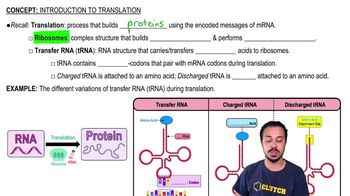
Translation is the process by which ribosomes synthesize proteins using messenger RNA (mRNA) as a template. During translation, the ribosome reads the sequence of codons in the mRNA and assembles the corresponding amino acids into a polypeptide chain, ultimately folding into a functional protein.
Recommended video:
Guided course
06:12
Introduction to Translation

Ribosome

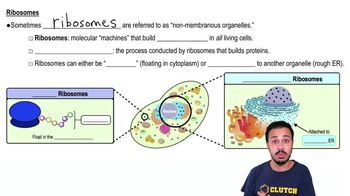
The ribosome is a complex molecular machine found within all living cells that facilitates the translation of mRNA into proteins. It consists of ribosomal RNA (rRNA) and proteins, and it has two subunits that come together during protein synthesis to read the mRNA and catalyze the formation of peptide bonds between amino acids.
Recommended video:

mRNA

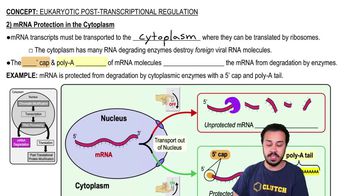
Messenger RNA (mRNA) is a type of RNA that carries genetic information from DNA to the ribosome, where it serves as a template for protein synthesis. The sequence of nucleotides in mRNA is organized into codons, each of which specifies a particular amino acid, guiding the ribosome in assembling the correct protein.
Recommended video:
Guided course
04:08
2) mRNA Protection in the Cytoplasm
Related Practice
Textbook Question

Which of the following is true of a codon?

a. It never codes for the same amino acid as another codon.

b. It can code for more than one amino acid.

c. It can be either in DNA or in RNA

d. It is the basic unit of protein structure

2912
views
Textbook Question

The anticodon of a particular tRNA molecule is

a. Complementary to the corresponding mRNA codon

b. Complementary to the corresponding triplet in rRNA

c. The part of tRNA that bonds to a specific amino acid

d. Catalytic, making the tRNA a ribozyme

3102
views
Textbook Question

Which of the following is true of RNA processing? (A) Exons are cut out before mRNA leaves the nucleus. (B) Nucleotides are added at both ends of the RNA. (C) Ribozymes may function in the addition of a 5′ cap. (D) RNA splicing adds a poly-A tail to the mRNA.

5252
views
Textbook Question

Using Figure 17.6, identify a 5′→3′ sequence of nucleotides in the DNA template strand for an mRNA coding for the polypeptide sequence Phe-Pro-Lys.


a. 5′-UUUCCCAAA-3′

b. 5′-GAACCCCTT-3′

c. 5′-CTTCGGGAA-3′

d. 5′-AAACCCUUU-3′

3104
views
Textbook Question

Which of the following mutations would be most likely to have a harmful effect on an organism?

a. A deletion of three nucleotides near the middle of a gene

b. A single nucleotide deletion in the middle of an intron

c. A single nucleotide deletion near the end of the coding sequence

d. A single nucleotide insertion downstream of, and close to, the start of the coding sequence

6106
views
Textbook Question

Would the coupling of the processes shown in Figure 17.24 be found in a eukaryotic cell? Explain why or why not.

<IMAGE>

773
views