Ch. 28 - Protists
Campbell - Campbell Biology 12th Edition
Urry12th EditionCampbell BiologyISBN: 9785794169850Not the one you use?Change textbook
Chapter 28, Problem 6

Based on the phylogenetic tree in Figure 28.5, which of the following statements is correct?
a. Excavata and SAR form a sister group
b. The most recent common ancestor of SAR is older than that of Unikonta
c. The most basal (first to diverge) eukaryotic supergroup cannot be determined
d. Excavata is the most basal eukaryotic supergroup

Verified step by step guidance
1
Understand the concept of a phylogenetic tree: A phylogenetic tree is a diagram that represents evolutionary relationships among various biological species based upon similarities and differences in their physical or genetic characteristics.
Identify the key components of the phylogenetic tree: Look for the nodes, branches, and the root of the tree. Nodes represent common ancestors, branches show evolutionary paths, and the root is the most ancestral form.
Examine the relationships between groups: Determine which groups are sister groups, meaning they share a common ancestor not shared by other groups. Look for the branching points that indicate these relationships.
Analyze the age of common ancestors: Compare the positions of nodes to determine the relative ages of common ancestors. Nodes closer to the root are older, while those further away are more recent.
Determine the basal group: The basal group is the one that diverged first from the common ancestor. Look at the branching pattern from the root to identify which group diverged first.

Verified video answer for a similar problem:

This video solution was recommended by our tutors as helpful for the problem above.
Video duration:
2m
Was this helpful?

Key Concepts

Here are the essential concepts you must grasp in order to answer the question correctly.

Phylogenetic Tree

A phylogenetic tree is a diagram that represents evolutionary relationships among various biological species based on similarities and differences in their physical or genetic characteristics. The tree's branches indicate how species or groups are related through common ancestors, with the root representing the most recent common ancestor of all entities on the tree.
Recommended video:
04:13
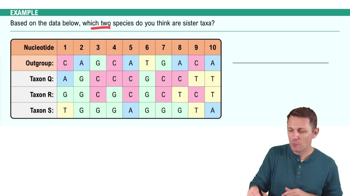
Building Phylogenetic Trees Example 2

Sister Groups

Sister groups are two descendants that split from the same node in a phylogenetic tree, indicating they share an immediate common ancestor. Understanding sister groups is crucial for interpreting evolutionary relationships, as they help identify which groups are more closely related to each other compared to others on the tree.
Recommended video:
Guided course
06:04
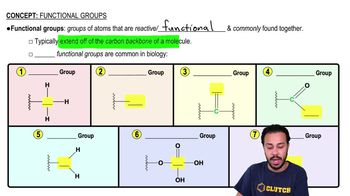
Functional Groups

Basal Group

A basal group in a phylogenetic tree refers to the earliest diverging lineage within a clade, often depicted as the first branch from the root. Identifying the basal group helps in understanding the evolutionary history and ancestral traits of the clade, although it can sometimes be challenging to determine due to incomplete data or complex evolutionary histories.
Recommended video:
Guided course
06:04
Functional Groups