Pearson+ LogoPearson+ Logo
Ch. 53 - Population Ecology
Campbell - Campbell Biology 12th Edition
Urry12th EditionCampbell BiologyISBN: 9785794169850Not the one you use?Change textbook
Chapter 53, Problem 3

Scientific study of the population cycles of the snowshoe hare and its predator, the lynx has revealed that
a. Predation is the dominant factor affecting prey population cycling.
b. Hares and lynx are so mutually dependent that each species cannot survive without the other.
c. Both hare and lynx population sizes are affected mainly by abiotic factors.
d. The hare population is r-selected and the lynx population is K-selected.

Verified step by step guidance
1
Understand the concept of population cycles: Population cycles refer to the fluctuations in population size over time, often influenced by various factors including predation, resource availability, and environmental conditions.
Examine the role of predation: Predation can significantly impact prey populations by controlling their numbers. Consider how the lynx, as a predator, might affect the snowshoe hare population through predation.
Consider mutual dependence: Evaluate whether the snowshoe hare and lynx populations are interdependent, meaning that the survival of one species is closely linked to the presence of the other.
Analyze abiotic factors: Abiotic factors such as climate, habitat, and food availability can influence population sizes. Determine if these factors play a major role in the population cycles of hares and lynxes.
Differentiate between r-selected and K-selected species: r-selected species typically have high reproductive rates and short lifespans, while K-selected species have lower reproductive rates and longer lifespans. Assess whether the hare and lynx fit these descriptions.

Verified video answer for a similar problem:

This video solution was recommended by our tutors as helpful for the problem above.
Video duration:
3m
Was this helpful?

Key Concepts

Here are the essential concepts you must grasp in order to answer the question correctly.

Predation and Population Dynamics

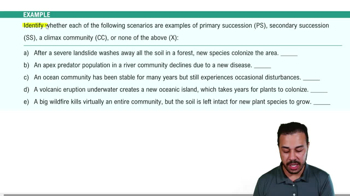
Predation is a biological interaction where a predator feeds on its prey, significantly influencing the population dynamics of both species. In the context of the snowshoe hare and lynx, predation is a critical factor that can lead to cyclical fluctuations in their populations, as the predator's survival depends on the availability of prey, and vice versa.
Recommended video:
Guided course
03:01
Community Dynamics Example 1

R-selected and K-selected Species

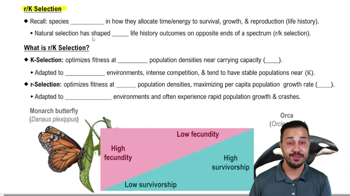
R-selected species, like the snowshoe hare, are characterized by high reproductive rates, short generation times, and the ability to exploit unstable environments. In contrast, K-selected species, such as the lynx, tend to have lower reproductive rates, longer lifespans, and are adapted to stable environments where they compete for limited resources. These strategies affect how each species responds to environmental pressures.
Recommended video:
Guided course
04:08
r/K Selection

Abiotic Factors in Population Ecology

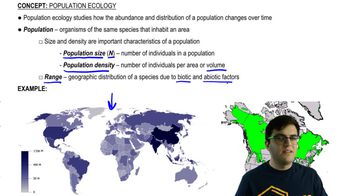
Abiotic factors are non-living chemical and physical components of the environment, such as temperature, water availability, and habitat conditions, that can influence the population sizes of organisms. In the study of hare and lynx populations, understanding how these factors impact each species is crucial, as they can affect food availability, habitat suitability, and survival rates, thereby influencing population cycles.
Recommended video:
Guided course
05:45
Population Ecology
Related Practice
Textbook Question

Population ecologists follow the fate of same-age cohorts to

a. Determine a population's carrying capacity

b. Determine the birth rate and death rate of each group in a population

c. Determine if a population is regulated by density-dependent processes

d. Determine the factors that affect the size of a population

895
views
Textbook Question

A population's carrying capacity

a. May change as environmental conditions change

b. Can be accurately calculated using the logistic growth model

c. Increases as the per capita population growth rate decreases

d. Can never be exceeded

2022
views
Textbook Question

Analyzing ecological footprints reveals that

a. Earth's carrying capacity would increase if per capita meat consumption increased.

b. Current demand by industrialized countries for resources is much smaller than the ecological footprint of those countries.

c. It is not possible for technological improvements to increase Earth's carrying capacity for humans.

d. The ecological footprint of the United States is large because per capita resource use is high.

1051
views
Textbook Question

Based on current growth rates, Earth's human population in 2019 will be closest to

a. 2.5 million

b. 4.5 billion

c. 7.5 billion

d. 10.5 billion

1246
views
Textbook Question

The observation that members of a population are uniformly distributed suggests that

a. Resources are distributed unevenly.

b. The members of the population are competing for access to a resource.

c. The members of the population are neither attracted to nor repelled by one another.

d. The density of the population is low.

1247
views