
Pearson+ LogoPearson+ Logo
Ch. 29 - Plant Diversity I: How Plants Colonized Land
Campbell - Campbell Biology 11th Edition
Urry11th EditionCampbell BiologyISBN: 9789357423311Not the one you use?Change textbook
Chapter 29, Problem 7

Draw a phylogenetic tree that represents our current understanding of evolutionary relationships between a moss, a gymnosperm, a lycophyte, and a fern. Use a charophyte alga as the outgroup. (See Figure 26.5 to review phylogenetic trees.) Label each branch point of the phylogeny with at least one derived character unique to the clade descended from the common ancestor represented by the branch point.

Verified step by step guidance
1
Start by identifying the outgroup, which is the charophyte alga. This group is used as a reference point to root the phylogenetic tree and helps in understanding the evolutionary relationships among the other groups.
Next, identify the major clades: moss, lycophyte, fern, and gymnosperm. These groups represent different evolutionary paths within the plant kingdom.
Determine the derived characters that are unique to each clade. For example, mosses are non-vascular plants, lycophytes have microphylls, ferns have megaphylls, and gymnosperms have seeds.
Draw the phylogenetic tree starting with the charophyte alga as the base or root. From this point, branch out to the moss, which is the most basal group among the land plants.
Continue branching to the lycophyte, then to the fern, and finally to the gymnosperm. Label each branch point with the derived character that is unique to the clade descended from that common ancestor, such as the development of vascular tissue, leaves, and seeds.

Verified video answer for a similar problem:

This video solution was recommended by our tutors as helpful for the problem above.
Video duration:
2m
Was this helpful?

Key Concepts

Here are the essential concepts you must grasp in order to answer the question correctly.

Phylogenetic Tree

A phylogenetic tree is a diagram that represents evolutionary relationships among various biological species based on similarities and differences in their physical or genetic characteristics. Each branch point, or node, represents a common ancestor, and the branches indicate the evolutionary path. Understanding how to read and construct these trees is crucial for visualizing the evolutionary history of organisms.
Recommended video:
04:13
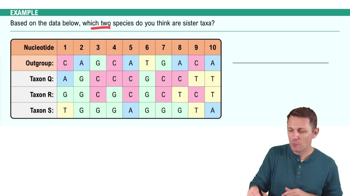
Building Phylogenetic Trees Example 2

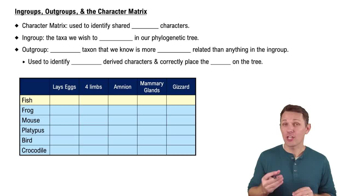
Outgroup

An outgroup is a species or group of species that is closely related to but not part of the group of species being studied. In phylogenetic analysis, the outgroup is used as a point of reference for rooting the tree and helps to infer the ancestral state of the characters. In this context, the charophyte alga serves as the outgroup, providing a baseline for comparing the evolutionary traits of the moss, gymnosperm, lycophyte, and fern.
Recommended video:
10:06
Ingroups, Outgroups, & the Character Matrix

Derived Character

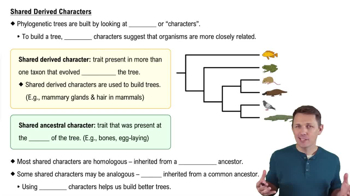
A derived character is a trait that is present in an organism but was absent in the last common ancestor of the group being considered. These characters are used to define clades and are crucial for understanding evolutionary relationships. In the phylogenetic tree, each branch point should be labeled with at least one derived character unique to the clade that descends from that point, helping to illustrate the evolutionary divergence of the species.
Recommended video:
05:42
Shared Derived Characters