

Pearson+ LogoPearson+ Logo
Ch. 29 - Plant Diversity I: How Plants Colonized Land
Campbell - Campbell Biology 11th Edition
Urry11th EditionCampbell BiologyISBN: 9789357423311Not the one you use?Change textbook
Chapter 29, Problem 4

Microphylls are found in which plant group?
a. Lycophytes
b. Liverworts
c. Ferns
d. Hornworts

Verified step by step guidance
1
Understand the term 'microphylls': Microphylls are a type of leaf characterized by having a single, unbranched vein. They are typically small and simple in structure.
Identify the plant groups listed in the options: The options given are lycophytes, liverworts, ferns, and hornworts.
Recall the characteristics of lycophytes: Lycophytes are a group of seedless vascular plants that include club mosses, spike mosses, and quillworts. They are known for having microphylls.
Consider the characteristics of liverworts, ferns, and hornworts: Liverworts and hornworts are non-vascular plants, while ferns are vascular plants with larger, more complex leaves called megaphylls.
Conclude which plant group has microphylls: Based on the characteristics, lycophytes are the plant group known for having microphylls.

Verified video answer for a similar problem:

This video solution was recommended by our tutors as helpful for the problem above.
Video duration:
26s
Was this helpful?

Key Concepts

Here are the essential concepts you must grasp in order to answer the question correctly.

Microphylls

Microphylls are small, simple leaves with a single, unbranched vein, typically found in certain plant groups. They are characteristic of lycophytes, a group of seedless vascular plants. Unlike megaphylls, microphylls do not have a complex network of veins, which is a key distinguishing feature.
Recommended video:
Guided course
04:08
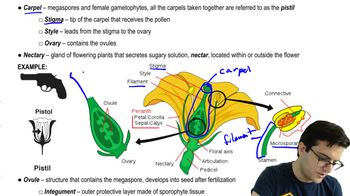
Flower Anatomy

Lycophytes

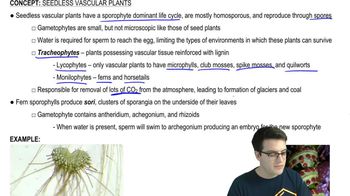
Lycophytes are an ancient group of vascular plants that include club mosses, spike mosses, and quillworts. They are characterized by having microphylls and reproduce via spores rather than seeds. Lycophytes are among the earliest vascular plants, and their simple leaf structure is a defining trait.
Recommended video:
Guided course
06:08
Seedless Vascular Plants

Plant Groups

Understanding plant groups is essential for identifying characteristics like leaf structure. Lycophytes, liverworts, ferns, and hornworts are distinct groups with unique features. For example, liverworts and hornworts are non-vascular, while ferns have complex leaves called fronds, unlike the microphylls of lycophytes.
Recommended video:
Guided course
06:04
Functional Groups
Related Practice
Textbook Question

Three of the following are evidence that charophytes are the closest algal relatives of plants. Select the exception.

a. Similar sperm structure

b. The presence of chloroplasts

c. Similarities in cell wall formation during cell division

d. Genetic similarities in chloroplasts

1603
views
Textbook Question

Which of the following characteristics of plants is absent in their closest relatives, the charophyte algae?

a. Chlorophyll b

b. Cellulose in cell walls

c. Sexual reproduction

d. Alternation of multicellular generations

1751
views
Textbook Question

In plants, which of the following are produced by meiosis?

a. Haploid gametes

b. Diploid gametes

c. Haploid spores

d. Diploid spores

1584
views
1
rank
Textbook Question

Suppose an efficient conducting system evolved in a moss that could transport water and other materials as high as a tall tree. Which of the following statements about 'trees' of such a species would not be true?

a. Spore dispersal distances would probably increase.

b. Females could produce only one archegonium.

c. Unless its body parts were strengthened, such a 'tree' would probably flop over.

d. Individuals would probably compete more effectively for access to light.

1137
views
Textbook Question

Identify each of the following structures as haploid or diploid.

a. Sporophyte

b. Spore

c. Gametophyte

d. Zygote

1241
views
Textbook Question

Draw a phylogenetic tree that represents our current understanding of evolutionary relationships between a moss, a gymnosperm, a lycophyte, and a fern. Use a charophyte alga as the outgroup. (See Figure 26.5 to review phylogenetic trees.) Label each branch point of the phylogeny with at least one derived character unique to the clade descended from the common ancestor represented by the branch point.

1817
views