

Pearson+ LogoPearson+ Logo
Ch. 7 - Membrane Structure and Function
Campbell - Campbell Biology 11th Edition
Urry11th EditionCampbell BiologyISBN: 9789357423311Not the one you use?Change textbook
Chapter 7, Problem 1

In what way do the membranes of a eukaryotic cell vary?
a. Phospholipids are found only in certain membranes.
b. Certain proteins are unique to each membrane.
c. Only certain membranes of the cell are selectively permeable.
d. Only certain membranes are constructed from amphipathic molecules.

Verified step by step guidance
1
Understand that eukaryotic cells have various types of membranes, each with specific functions and compositions.
Recognize that phospholipids are a fundamental component of all eukaryotic cell membranes, not just certain ones, making option a incorrect.
Identify that proteins embedded in membranes can vary significantly between different types of membranes, as they are tailored to the specific functions of each membrane, supporting option b.
Recall that all eukaryotic cell membranes exhibit selective permeability, allowing certain substances to pass while blocking others, which makes option c incorrect.
Note that amphipathic molecules, such as phospholipids, are a common structural feature of all cell membranes, not just certain ones, making option d incorrect.

Verified video answer for a similar problem:

This video solution was recommended by our tutors as helpful for the problem above.
Video duration:
41s
Was this helpful?

Key Concepts

Here are the essential concepts you must grasp in order to answer the question correctly.

Membrane Composition

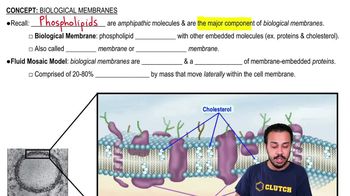
Eukaryotic cell membranes are primarily composed of a phospholipid bilayer, which provides structural integrity and fluidity. Phospholipids are amphipathic molecules, meaning they have both hydrophilic and hydrophobic parts, allowing them to form bilayers. While phospholipids are common to all membranes, the specific types and ratios can vary, influencing membrane properties.
Recommended video:
Guided course
06:04
Biological Membranes

Membrane Proteins

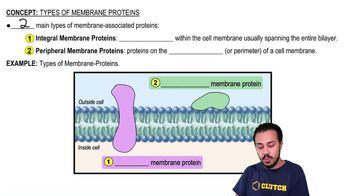
Membrane proteins are crucial for various functions, including transport, signaling, and structural support. Each membrane within a eukaryotic cell can have a unique set of proteins tailored to its specific function. For example, the mitochondrial membrane has proteins involved in energy production, while the plasma membrane contains receptors for cell communication.
Recommended video:
Guided course
02:35
Types of Membrane Proteins

Selective Permeability

Selective permeability refers to a membrane's ability to regulate the passage of substances. This property is essential for maintaining homeostasis within the cell. While all eukaryotic membranes exhibit selective permeability to some degree, the extent and specificity can vary depending on the membrane's role, such as the nuclear envelope selectively allowing RNA and proteins to pass.
Recommended video:
04:43
Natural Selection