
Ch. 14 - Mendel and the Gene
Freeman - Biological Science 8th Edition
Freeman8th EditionBiological ScienceISBN: 9780138276263Not the one you use?Change textbook
Chapter 14, Problem 16d

You have crossed two Drosophila melanogaster individuals that have long wings and red eyes—the wild-type phenotype. In the progeny, curved wings and lozenge eyes mutant phenotypes appear as follows: What is the genotype of the male parent?

Verified step by step guidance
1
Step 1: Begin by understanding the phenotypes and genotypes involved. The wild-type phenotype in Drosophila melanogaster is long wings and red eyes. The mutant phenotypes are curved wings and lozenge eyes.
Step 2: Analyze the progeny data provided in the table. The progeny includes both wild-type and mutant phenotypes, indicating that the parents are heterozygous for the traits.
Step 3: Determine the possible genotypes for the wing trait. Long wings (wild-type) are dominant over curved wings (mutant). Therefore, the genotype for long wings can be either homozygous dominant (WW) or heterozygous (Ww). The appearance of curved wings in the progeny suggests the male parent is heterozygous (Ww).
Step 4: Determine the possible genotypes for the eye trait. Red eyes (wild-type) are dominant over lozenge eyes (mutant). Therefore, the genotype for red eyes can be either homozygous dominant (RR) or heterozygous (Rr). The appearance of lozenge eyes in the progeny suggests the male parent is heterozygous (Rr).
Step 5: Conclude that the genotype of the male parent is heterozygous for both traits, represented as WwRr, based on the presence of both mutant phenotypes in the progeny.

Verified video answer for a similar problem:

This video solution was recommended by our tutors as helpful for the problem above.
Video duration:
5m
Was this helpful?

Key Concepts

Here are the essential concepts you must grasp in order to answer the question correctly.

Drosophila melanogaster Genetics

Drosophila melanogaster, commonly known as the fruit fly, is a model organism in genetics. Its simple genetic structure and short life cycle make it ideal for studying inheritance patterns. The phenotypes of Drosophila, such as wing shape and eye color, are determined by specific alleles, which can be dominant or recessive, influencing the traits expressed in the offspring.
Recommended video:

Phenotype and Genotype

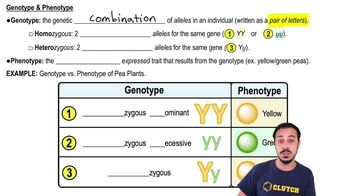
Phenotype refers to the observable characteristics of an organism, such as wing shape and eye color, while genotype refers to the genetic makeup that determines these traits. In this case, the wild-type phenotype (long wings and red eyes) is dominant, and the presence of mutant phenotypes in the progeny suggests that the parents' genotypes include both dominant and recessive alleles, affecting the traits expressed.
Recommended video:
Guided course
06:36
Genotype & Phenotype

Punnett Square and Inheritance Ratios

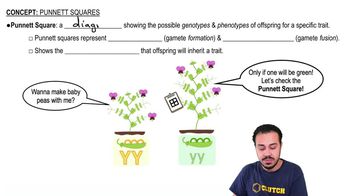
A Punnett square is a tool used to predict the genotypes of offspring from a genetic cross. By analyzing the ratios of phenotypes in the progeny, one can infer the genotypes of the parents. The observed ratios of long and curved wings, as well as red and lozenge eyes, can help determine the male parent's genotype by revealing the combinations of alleles passed on to the offspring.
Recommended video:
Guided course
01:37
Punnett Squares