Pearson+ LogoPearson+ Logo
Ch. 15 - DNA and the Gene: Synthesis and Repair
Freeman - Biological Science 8th Edition
Freeman8th EditionBiological ScienceISBN: 9780138276263Not the one you use?Change textbook
Chapter 15, Problem 5

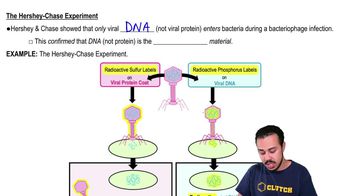
Researchers design experiments so that only one thing is different between the treatments that are being compared. In the Hershey–Chase experiment, what was this single difference?

Verified step by step guidance
1
Step 1: Understand the context of the Hershey-Chase experiment. This experiment was conducted by Alfred Hershey and Martha Chase in 1952 to determine whether DNA or proteins are the genetic material that viruses inject into bacteria to replicate.
Step 2: Recall the design of the Hershey-Chase experiment. They used two types of bacteriophages (viruses that infect bacteria): one with radioactive phosphorus-32 (P-32) in the DNA and another with radioactive sulfur-35 (S-35) in the protein coat.
Step 3: Identify the single difference between the treatments. The only difference between the two bacteriophages was the location of the radioactive label: one was in the DNA (P-32) and the other was in the protein coat (S-35).
Step 4: Understand the significance of this difference. By tracking where the radioactive labels ended up, Hershey and Chase could determine whether it was the DNA or the protein that was injected into the bacteria and thus, which one was the genetic material.
Step 5: Summarize the answer. The single difference in the Hershey-Chase experiment was the location of the radioactive label: in the DNA for one group of bacteriophages and in the protein coat for the other group.

Verified video answer for a similar problem:

This video solution was recommended by our tutors as helpful for the problem above.
Video duration:
1m
Was this helpful?

Key Concepts

Here are the essential concepts you must grasp in order to answer the question correctly.

Hershey-Chase Experiment

The Hershey-Chase experiment, conducted in 1952, was pivotal in demonstrating that DNA is the genetic material. Researchers used bacteriophages, viruses that infect bacteria, to show that when these viruses infect bacteria, it is the DNA, not the protein coat, that enters the bacterial cells and directs the production of new viruses.
Recommended video:
Guided course
03:59
The Hershey-Chase Experiment

Independent Variable

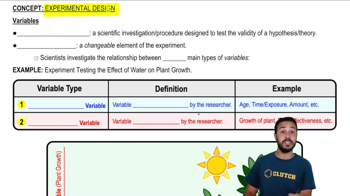
In experimental design, the independent variable is the factor that is intentionally changed or manipulated to observe its effect on the dependent variable. In the Hershey-Chase experiment, the independent variable was the type of labeled molecule (either DNA or protein) used to track which component was responsible for genetic inheritance.
Recommended video:

Radioactive Labeling

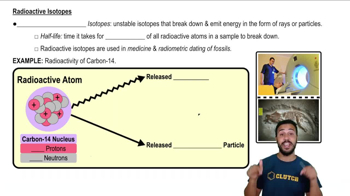
Radioactive labeling involves tagging molecules with radioactive isotopes to trace their movement and interactions in biological systems. In the Hershey-Chase experiment, phosphorus-32 was used to label DNA and sulfur-35 to label proteins, allowing researchers to determine which component was transmitted to the bacteria during infection.
Recommended video:
Guided course
02:37
Radioactive Isotopes
Related Practice
Textbook Question

What is the function of primase?

a. Synthesis of the repetitive, short double-stranded DNA sequences required by DNA polymerase.

b. Synthesis of a short RNA strand that is complementary to single-stranded DNA.

c. Closing the gap at the 3′ end of DNA after excision repair.

d. Removing primers and synthesizing a short section of DNA to replace them.

1202
views
Textbook Question

How are Okazaki fragments synthesized?

a. By using the leading-strand template, and synthesizing 5'→3'

b. By using the leading-strand template, and synthesizing 3'→5'

c. By using the lagging-strand template, and synthesizing 5'→3'

d. By using the lagging-strand template, and synthesizing 3'→5'.

1247
views
Textbook Question

Telomerase synthesizes DNA in the _____ direction.

995
views
Textbook Question

Analyze the following statements about DNA synthesis. Select True or False for each statement.

T/FAn RNA polymerase is essential for DNA synthesis.

T/FOkazaki fragments would be unnecessary if DNA polymerase could synthesize DNA in both the 3'→5' and 5'→3' directions.

T/FDNA ligase is used more frequently on the lagging strand than on the leading strand.

T/FToposiomerase is required to separate the two strands of DNA at the replication fork.

1748
views
Textbook Question

How does telomerase prevent linear chromosomes from shortening during replication?

774
views
Textbook Question

What aspect of DNA structure makes it possible for the proteins of nucleotide excision repair to recognize many different types of DNA damage?

(a) the polarity of each DNA strand

1612
views