Pearson+ LogoPearson+ Logo
Ch. 16 - How Genes Work
Freeman - Biological Science 8th Edition
Freeman8th EditionBiological ScienceISBN: 9780138276263Not the one you use?Change textbook
Chapter 16, Problem 2

Which of the following is an important exception to the central dogma of molecular biology?
a. Many genes code for RNAs that function directly in the cell.
b. DNA is the repository of genetic information in all cells.
c. Messenger RNA is a short-lived 'information carrier.
d. Proteins are responsible for most aspects of the phenotype.

Verified step by step guidance
1
Step 1: Begin by recalling the central dogma of molecular biology, which describes the flow of genetic information: DNA → RNA → Protein. This framework explains how genetic information is transcribed into RNA and then translated into proteins.
Step 2: Consider the exceptions to the central dogma. One major exception is that not all genes code for proteins. Some genes produce RNA molecules that function directly in the cell without being translated into proteins. These include ribosomal RNA (rRNA), transfer RNA (tRNA), and other non-coding RNAs.
Step 3: Evaluate each option in the problem. Option a states that many genes code for RNAs that function directly in the cell, which aligns with the exception mentioned above. Option b refers to DNA as the repository of genetic information, which is a fundamental principle but not an exception. Option c describes messenger RNA as an information carrier, which is part of the central dogma, not an exception. Option d highlights the role of proteins in phenotype expression, which is also consistent with the central dogma.
Step 4: Identify the correct answer by focusing on the exception to the central dogma. The exception involves genes coding for functional RNAs rather than proteins, as described in option a.
Step 5: Conclude that understanding exceptions to the central dogma is important for appreciating the diverse roles of RNA in cellular processes, such as catalysis, regulation, and structural functions.

Verified video answer for a similar problem:

This video solution was recommended by our tutors as helpful for the problem above.
Video duration:
31s
Was this helpful?

Key Concepts

Here are the essential concepts you must grasp in order to answer the question correctly.

Central Dogma of Molecular Biology

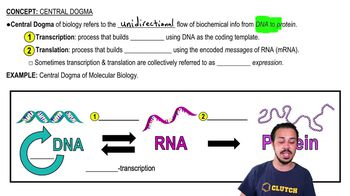
The central dogma of molecular biology describes the flow of genetic information within a biological system. It outlines the process where DNA is transcribed into RNA, which is then translated into proteins. This framework is fundamental for understanding how genetic information is expressed and regulated in cells.
Recommended video:
Guided course
05:45
Central Dogma

RNA Functions

While traditionally RNA was viewed primarily as a messenger between DNA and proteins, many genes code for non-coding RNAs that play crucial roles in cellular functions. These RNAs can include ribosomal RNA (rRNA) and transfer RNA (tRNA), as well as regulatory RNAs like microRNAs, which are essential for gene regulation and cellular processes.
Recommended video:
Guided course
06:04
Functional Groups

Phenotype and Protein Function

The phenotype of an organism refers to its observable characteristics, which are largely determined by the proteins it produces. Proteins perform a vast array of functions, including structural roles, enzymatic activity, and signaling, making them central to the expression of traits. Understanding the relationship between genotype, protein function, and phenotype is key to grasping biological processes.
Recommended video:
Guided course
03:54
Membrane Protein Functions