
Pearson+ LogoPearson+ Logo
Ch. 17 - Transcription, RNA Processing, and Translation
Freeman - Biological Science 8th Edition
Freeman8th EditionBiological ScienceISBN: 9780138276263Not the one you use?Change textbook
Chapter 17, Problem 11

<Image>
Eating even a single death cap mushroom (Amanita phalloides) can be fatal due to a compound called α-amanitin, a toxin that inhibits transcription.
What would you predict to be the immediate outcome of adding α-amanitin to a cell?
a. Reduced DNA synthesis
b. Reduced production of one or more types of RNA
c. Reduced binding of tRNAs to anticodons
d. Reduced rate of translocation of ribosomes translating mRNA

Verified step by step guidance
1
Understand the role of α-amanitin: α-amanitin is a toxin that specifically inhibits RNA polymerase II, the enzyme responsible for synthesizing messenger RNA (mRNA) during transcription. This means it directly affects the production of RNA in the cell.
Analyze the process of transcription: Transcription is the process by which DNA is used as a template to produce RNA. If transcription is inhibited, the production of RNA, including mRNA, transfer RNA (tRNA), and ribosomal RNA (rRNA), will be reduced.
Evaluate the options: a) DNA synthesis is not directly related to transcription, so this is unlikely to be affected. b) RNA production is directly impacted by the inhibition of RNA polymerase II, making this a likely outcome. c) Binding of tRNAs to anticodons occurs during translation, which is downstream of transcription and would not be immediately affected. d) The rate of ribosome translocation during translation depends on the availability of mRNA, which would only be affected after existing mRNA is depleted.
Focus on the immediate outcome: Since α-amanitin inhibits transcription, the immediate effect would be a reduction in the production of RNA, particularly mRNA, which is synthesized by RNA polymerase II.
Conclude the prediction: Based on the analysis, the most immediate outcome of adding α-amanitin to a cell would be reduced production of one or more types of RNA, as transcription is directly inhibited.

Verified video answer for a similar problem:

This video solution was recommended by our tutors as helpful for the problem above.
Video duration:
1m
Was this helpful?

Key Concepts

Here are the essential concepts you must grasp in order to answer the question correctly.

Transcription Inhibition

Transcription is the process by which RNA is synthesized from a DNA template. α-amanitin specifically inhibits RNA polymerase II, the enzyme responsible for synthesizing mRNA. This inhibition prevents the formation of RNA transcripts, leading to a decrease in the production of various types of RNA, including mRNA, which is crucial for protein synthesis.
Recommended video:
Guided course
05:03
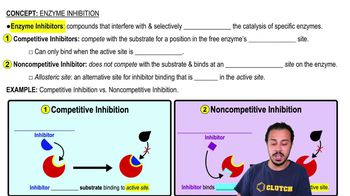
Enzyme Inhibition

RNA Types and Functions

Cells produce several types of RNA, including mRNA, tRNA, and rRNA, each serving distinct roles in gene expression and protein synthesis. mRNA carries genetic information from DNA to ribosomes, tRNA brings amino acids to ribosomes during translation, and rRNA is a structural component of ribosomes. Inhibition of transcription by α-amanitin would primarily affect mRNA levels, thereby impacting protein production.
Recommended video:
Guided course
07:20
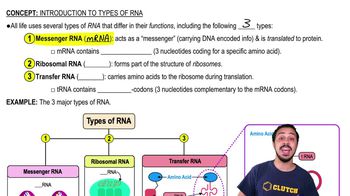
Introduction to Types of RNA

Effects of Toxins on Cellular Processes

Toxins like α-amanitin can disrupt normal cellular functions by targeting specific molecular pathways. In this case, the immediate effect of α-amanitin is a reduction in RNA synthesis, which can lead to decreased protein production and ultimately affect cell viability. Understanding how toxins interact with cellular machinery is crucial for predicting their biological effects.
Recommended video:
Guided course
04:19
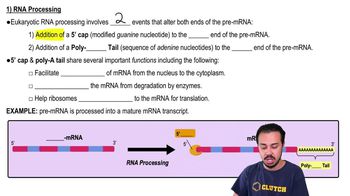
1) RNA Processing
Related Practice
Textbook Question

In what ways are a promoter and a start codon similar? In what ways are they different?

1719
views
Textbook Question

The nucleotide shown here is called cordycepin triphosphate. It is a natural product of a fungus that is used in traditional medicines.

If cordycepin triphosphate is added to a cell-free transcription reaction, the nucleotide is added onto the growing RNA chain but then no more nucleotides can be added. Examine the structure of cordycepin and explain why it ends transcription.

1112
views
Textbook Question

Controlling the rates of transcription and translation is important in bacteria to avoid collisions between ribosomes and RNA polymerases. Calculate what the maximum rate of translation by a ribosome in a bacterial cell would have to be, in units of amino acids per second, so as not to overtake an RNA polymerase that is synthesizing mRNA at a rate of 60 nucleotides per second. How long would it take for this bacterial cell to translate an mRNA containing 1800 codons?

1105
views
Textbook Question

<Image>

Eating even a single death cap mushroom (Amanita phalloides) can be fatal due to a compound called α-amanitin, a toxin that inhibits transcription.

α-Amanitin inhibits transcription by binding inside an RNA polymerase to a region other than the active site that catalyzes addition of a nucleotide to the RNA chain. Based on the model of RNA polymerase shown in Figure 17.3, predict how the toxin might function to inhibit transcription.

1632
views
Textbook Question

<Image>

Eating even a single death cap mushroom (Amanita phalloides) can be fatal due to a compound called α-amanitin, a toxin that inhibits transcription.

Toxins like α-amanitin are used for research in much the same way as null mutants (Chapter 16)—to disrupt a process and see what happens when it no longer works. Researchers examined the ability of α-amanitin to inhibit different RNA polymerases. They purified RNA polymerases I, II, and III from rat liver, incubated the enzymes with different concentrations of α-amanitin, and then tested their activity. The results of this experiment are shown here. These findings suggest that cells treated with α-amanitin will have a reduced level of:

a. tRNAs

b. rRNAs

c. snRNAs

d. mRNAs

1387
views
Textbook Question

<Image>

Eating even a single death cap mushroom (Amanita phalloides) can be fatal due to a compound called α-amanitin, a toxin that inhibits transcription.

If you wanted to use α-amanitin to shut down 95 percent of transcription by RNA polymerase II, roughly what concentration of α-amanitin would you use? Note that the scale on the x-axis of the graph in Question 13 is logarithmic rather than linear, so that each tick mark shows a tenfold higher concentration.

1570
views