
Pearson+ LogoPearson+ Logo
Ch. 17 - Transcription, RNA Processing, and Translation
Freeman - Biological Science 8th Edition
Freeman8th EditionBiological ScienceISBN: 9780138276263Not the one you use?Change textbook
Chapter 17, Problem 9

The nucleotide shown here is called cordycepin triphosphate. It is a natural product of a fungus that is used in traditional medicines.

If cordycepin triphosphate is added to a cell-free transcription reaction, the nucleotide is added onto the growing RNA chain but then no more nucleotides can be added. Examine the structure of cordycepin and explain why it ends transcription.

Verified step by step guidance
1
Examine the structure of cordycepin triphosphate in the image. Note that it consists of a base, a sugar, and three phosphate groups attached to the 5' carbon of the sugar.
Identify the key structural difference between cordycepin and a typical nucleotide. In a normal nucleotide, the sugar has both a 3' hydroxyl (-OH) group and a 2' hydroxyl (-OH) group. However, cordycepin lacks the 3' hydroxyl group, which is replaced by a hydrogen atom.
Understand the role of the 3' hydroxyl group in RNA synthesis. During transcription, the 3' hydroxyl group of the growing RNA chain attacks the incoming nucleotide's phosphate group, forming a phosphodiester bond. This reaction is essential for elongating the RNA chain.
Explain why the absence of the 3' hydroxyl group in cordycepin prevents further elongation. Without the 3' hydroxyl group, the RNA chain cannot form a phosphodiester bond with the next nucleotide, effectively halting transcription.
Conclude that cordycepin acts as a chain terminator in transcription because its structure prevents the addition of subsequent nucleotides to the RNA chain.

Verified video answer for a similar problem:

This video solution was recommended by our tutors as helpful for the problem above.
Video duration:
31s
Was this helpful?

Key Concepts

Here are the essential concepts you must grasp in order to answer the question correctly.

Nucleotide Structure

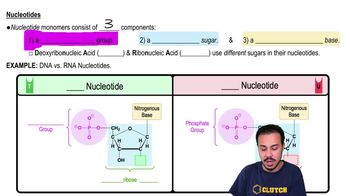
Nucleotides are the building blocks of nucleic acids, consisting of a phosphate group, a sugar, and a nitrogenous base. In the case of cordycepin triphosphate, the structure includes a ribose sugar with three phosphate groups attached. The presence of these components is crucial for the nucleotide's role in RNA synthesis and its ability to form phosphodiester bonds with adjacent nucleotides.
Recommended video:

Transcription Termination

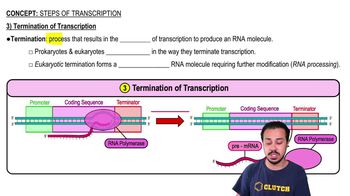
Transcription termination occurs when RNA polymerase stops synthesizing RNA, often triggered by specific signals or structural features of the RNA. In the case of cordycepin triphosphate, its unique structure prevents the addition of further nucleotides due to the absence of a 3' hydroxyl group, which is essential for forming the phosphodiester bond with the next nucleotide, effectively halting the transcription process.
Recommended video:
Guided course
02:44
3) Termination of Transcription

Cordycepin's Mechanism of Action

Cordycepin, a derivative of adenosine, acts as a chain terminator during RNA synthesis. When incorporated into the growing RNA strand, its structure lacks a 3' hydroxyl group, which is necessary for the addition of subsequent nucleotides. This structural limitation leads to the premature termination of RNA synthesis, making cordycepin a valuable tool in studying transcription and potential therapeutic applications.
Recommended video:
Guided course
09:55
Action Potential
Related Practice
Textbook Question

For each of these statements about the genetic code, select True or False.

a. T/F Wobble pairing accounts for the redundancy of the genetic code.

b. T/F There are 64 different tRNAs that read the 64 possible codons.

c. T/F All possible codons are used, but not all codons specify an amino acid.

d. T/F Some codons are recognized by proteins, not by tRNAs.

1197
views
Textbook Question

In a particular bacterial species, temperature-sensitive conditional mutations cause expression of a wild-type phenotype at one growth temperature and a mutant phenotype at another—typically higher—temperature. Imagine that when a bacterial cell carrying such a mutation is shifted from low to high growth temperatures, RNA polymerases in the process of elongation complete transcription normally, but no new transcripts can be started. The mutation in this strain most likely affects:

a. The terminator sequence

b. The start codon

c. Sigma

d. One of the polypeptides of the core RNA polymerase

1063
views
Textbook Question

In what ways are a promoter and a start codon similar? In what ways are they different?

1720
views
Textbook Question

Controlling the rates of transcription and translation is important in bacteria to avoid collisions between ribosomes and RNA polymerases. Calculate what the maximum rate of translation by a ribosome in a bacterial cell would have to be, in units of amino acids per second, so as not to overtake an RNA polymerase that is synthesizing mRNA at a rate of 60 nucleotides per second. How long would it take for this bacterial cell to translate an mRNA containing 1800 codons?

1105
views
Textbook Question

<Image>

Eating even a single death cap mushroom (Amanita phalloides) can be fatal due to a compound called α-amanitin, a toxin that inhibits transcription.

What would you predict to be the immediate outcome of adding α-amanitin to a cell?

a. Reduced DNA synthesis

b. Reduced production of one or more types of RNA

c. Reduced binding of tRNAs to anticodons

d. Reduced rate of translocation of ribosomes translating mRNA

1140
views
Textbook Question

<Image>

Eating even a single death cap mushroom (Amanita phalloides) can be fatal due to a compound called α-amanitin, a toxin that inhibits transcription.

α-Amanitin inhibits transcription by binding inside an RNA polymerase to a region other than the active site that catalyzes addition of a nucleotide to the RNA chain. Based on the model of RNA polymerase shown in Figure 17.3, predict how the toxin might function to inhibit transcription.

1632
views