

Pearson+ LogoPearson+ Logo
Ch. 21 - Genes, Development, and Evolution
Freeman - Biological Science 8th Edition
Freeman8th EditionBiological ScienceISBN: 9780138276263Not the one you use?Change textbook
Chapter 21, Problem 6

The following predictions ask you to consider how genetic regulatory cascades provide positional information. Select True or False for each statement.
T/F Mutation of a gene at one level of a regulatory cascade will affect the expression of genes at all levels of the cascade.
T/F Mutation of a gene that is expressed later in a regulatory cascade will affect a smaller region of the body than mutation of gene that is expressed early in the cascade.
T/F In the regulatory cascade used by Drosophila, a gene at one level of the cascade will be controlled only by genes at the level immediately above it.
T/F Genes that control the largest regions of the Drosophila embryo are not transcribed in the embryo.

Verified step by step guidance
1
Understand the concept of genetic regulatory cascades: These are sequences of gene activations where one gene's expression influences the expression of subsequent genes. This cascade provides positional information during development.
Consider the first statement: A mutation in a gene at one level of a regulatory cascade can affect the expression of genes at all levels below it, as the cascade relies on sequential activation. Reflect on how upstream mutations can have downstream effects.
Analyze the second statement: A gene expressed later in the cascade typically affects a smaller region because earlier genes set up broad positional information, while later genes refine and specify details. Consider the hierarchical nature of gene expression in development.
Evaluate the third statement: In Drosophila, regulatory cascades often involve multiple levels of control, where genes can be influenced by factors beyond the immediately preceding level. Think about the complexity of gene interactions and regulatory networks.
Examine the fourth statement: Genes controlling large regions of the Drosophila embryo, such as maternal effect genes, are often transcribed in the mother and not in the embryo itself. Consider the role of maternal contributions in early development.

Verified video answer for a similar problem:

This video solution was recommended by our tutors as helpful for the problem above.
Video duration:
2m
Was this helpful?

Key Concepts

Here are the essential concepts you must grasp in order to answer the question correctly.

Genetic Regulatory Cascades

Genetic regulatory cascades are sequences of gene activations where one gene's expression influences the expression of subsequent genes. These cascades are crucial for developmental processes, providing positional information that guides the spatial and temporal expression of genes, ultimately shaping the organism's structure and function.
Recommended video:
Guided course
02:35
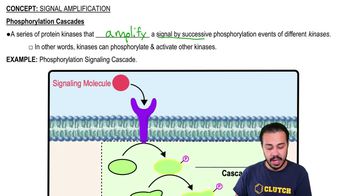
Phosphorylation Cascades

Positional Information

Positional information refers to the spatial cues within an organism that guide cells to develop into specific structures. In genetic regulatory cascades, genes provide positional information by activating or repressing other genes, ensuring that cells differentiate appropriately based on their location within the developing embryo.
Recommended video:
Guided course
02:19
Positive Feedback

Gene Expression Hierarchy

Gene expression hierarchy in regulatory cascades involves genes being activated in a specific order, where early-expressed genes often control larger developmental regions than those expressed later. Mutations in early genes can have widespread effects, while mutations in later genes typically affect more localized areas, reflecting their position in the cascade.
Recommended video:
Guided course
06:40
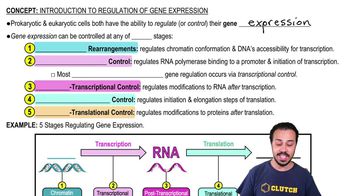
Introduction to Regulation of Gene Expression
Related Practice
Textbook Question

What is a homeotic mutant?

a. An individual with a structure located in the wrong place

b. An individual with an abnormal head-to-tail axis

c. An individual that is missing segments

d. An individual with double the normal number of structures

842
views
Textbook Question

A tool-kit gene is               .

769
views
Textbook Question

A friend is interested in isolating genes that are expressed solely in liver cells but only has access to skin cells. She asks you for advice on whether to start her studies. What will you say?

590
views
Textbook Question

What is the connection between genetic regulatory cascades and the observation that differentiation is a step-by-step process?

629
views
Textbook Question

Which of the following provides the strongest evidence for the conservation of tool-kit genes?

a. Bicoid moved from one fly embryo into the posterior of another fly embryo causes the formation of two head regions.

b. Mutation of an unrelated gene in another species of fly has a similar effect to mutation of bicoid in Drosophila.

c. A mouse Hox gene can be used to take over the function of a mutated Drosophila Hox gene.

d. Sheep can be cloned by fusing a differentiated adult cell with an enucleated egg.

567
views
Textbook Question

Imagine a situation in which a morphogen has its source at the posterior end of a Drosophila embryo. Every 100 µm from the posterior pole, the morphogen concentration decreases by half. If a cell required 1/16th the amount of morphogen found at the posterior pole to form part of a leg, how far from the posterior pole would the leg form?

a. 100μm

b. 160μm

c. 400μm

d. 1600 μm

605
views