Pearson+ LogoPearson+ Logo
Ch. 22 - Evolution by Natural Selection
Freeman - Biological Science 8th Edition
Freeman8th EditionBiological ScienceISBN: 9780138276263Not the one you use?Change textbook
Chapter 22, Problem 2

Why does the presence of extinct forms and transitional features in the fossil record support the pattern component of the theory of evolution by natural selection? Select True or False for each statement.
T/F It supports the hypothesis that individuals change over time.
T/F It supports the hypothesis that weaker species are eliminated by natural selection.
T/F It supports the hypothesis that species evolve to become more complex and better adapted over time.
T/F It supports the hypothesis that species change over time.

Verified step by step guidance
1
Understand the context of the problem: The question is asking about how the fossil record supports the theory of evolution by natural selection. Specifically, it focuses on the presence of extinct forms and transitional features, which are key evidence for evolutionary change over time.
Clarify the concept of transitional features: Transitional features are traits in fossils that show intermediate characteristics between ancestral and derived species. These features provide evidence that species have changed over time, supporting the idea of evolution.
Analyze each statement: For each hypothesis, determine whether it aligns with the evidence provided by the fossil record. For example, the fossil record does not directly support the idea that individuals change over time (evolution occurs at the population level, not the individual level).
Evaluate the role of natural selection: The fossil record supports the idea that weaker species may be eliminated over time, but this is a simplification. Natural selection favors traits that increase fitness, which may lead to the extinction of less adapted species.
Assess the complexity and adaptation hypothesis: While the fossil record shows that species change over time, it does not necessarily support the idea that species always evolve to become more complex. Evolution is not inherently directional; it depends on environmental pressures and survival needs.

Verified video answer for a similar problem:

This video solution was recommended by our tutors as helpful for the problem above.
Video duration:
2m
Was this helpful?

Key Concepts

Here are the essential concepts you must grasp in order to answer the question correctly.

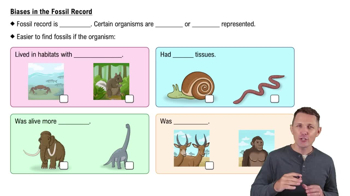
Fossil Record

The fossil record is a historical archive of biological remains that provides evidence of past life forms and their evolution over time. It includes transitional fossils, which exhibit traits common to both ancestral and descendant groups, illustrating the gradual changes that occur in species. This record supports the theory of evolution by showing how species have adapted and diversified through natural selection.
Recommended video:
03:17
Biases in the Fossil Record

Natural Selection

Natural selection is a fundamental mechanism of evolution, proposed by Charles Darwin, where individuals with advantageous traits are more likely to survive and reproduce. This process leads to the gradual adaptation of species to their environments. The presence of transitional features in fossils supports the idea that species evolve over time through this selective process, as those with beneficial adaptations are favored.
Recommended video:
04:43
Natural Selection

Evolutionary Change

Evolutionary change refers to the process by which species undergo modifications over generations, leading to the emergence of new species and the extinction of others. This concept encompasses the idea that species are not static but dynamic, adapting to environmental pressures. The fossil record, with its extinct forms and transitional features, provides concrete evidence that species change over time, supporting the broader theory of evolution.
Recommended video:
02:45
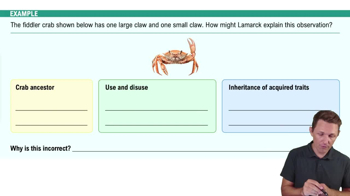
History of Evolutionary Theory Example 1