Ch. 26 - Bacteria and Archaea

Freeman8th EditionBiological ScienceISBN: 9780138276263
Not the one you use?Change textbookSelect a different textbook
Table of contents
- Ch. 1 - Biology: The Study of Life13
- Ch. 2 - Water and Carbon: The Chemical Basis of Life14
- Ch.3 - Protein Structure and Function10
- Ch.4 - Nucleic Acids and the RNA World10
- Ch. 5 - An Introduction to Carbohydrates10
- Ch. 6 - Lipids, Membranes, and the First Cells11
- Ch. 7 - Inside the Cell10
- Ch. 8 - Energy and Enzymes: An Introduction to Metabolism10
- Ch. 9 - Cellular Respiration and Fermentation11
- Ch. 10 - Photosynthesis12
- Ch. 11 - Cell-Cell Interactions12
- Ch. 12 - The Cell Cycle8
- Ch. 13 - Meiosis12
- Ch. 14 - Mendel and the Gene23
- Ch. 15 - DNA and the Gene: Synthesis and Repair15
- Ch. 16 - How Genes Work16
- Ch. 17 - Transcription, RNA Processing, and Translation16
- Ch. 18 - Control of Gene Expression in Bacteria16
- Ch. 19 - Control of Gene Expression in Eukaryotes12
- Ch. 20 - The Molecular Revolution: Biotechnology, Genomics, and New Frontiers15
- Ch. 21 - Genes, Development, and Evolution12
- Ch. 22 - Evolution by Natural Selection16
- Ch. 23 - Evolutionary Processes13
- Ch. 24 - Speciation15
- Ch. 25 - Phylogenies and the History of Life13
- Ch. 26 - Bacteria and Archaea15
- Ch. 27 - Diversification of Eukaryotes16
- Ch. 28 - Green Algae and Land Plants16
- Ch. 29 - Fungi18
- Ch. 30 - An Introduction to Animals9
- Ch. 31 - Protostome Animals15
- Ch. 32 - Deuterostome Animals17
- Ch. 33 - Viruses16
- Ch. 34 - Plant Form and Function16
- Ch. 35 - Water and Sugar Transport in Plants16
- Ch. 36 - Plant Nutrition13
- Ch. 37 - Plant Sensory Systems, Signals, and Responses16
- Ch. 38 - Flowering Plant Reproduction and Development16
- Ch. 39 - Animal Form and Function17
- Ch. 40 - Water and Electrolyte Balance in Animals16
- Ch. 41 - Animal Nutrition16
- Ch. 42 - Gas Exchange and Circulation16
- Ch. 43 - Animal Nervous Systems16
- Ch. 44 - Animal Sensory Systems16
- Ch. 45 - Animal Movement11
- Ch. 46 - Chemical Signals in Animals16
- Ch. 47 - Animal Reproduction and Development16
- Ch. 48 - The Immune System in Animals16
- Ch. 49 - An Introduction to Ecology15
- Ch. 50 - Behavioral Ecology16
- Ch. 51 - Population Ecology16
- Ch. 52 - Community Ecology20
- Ch. 53 - Ecosystems and Global Ecology17
- Ch. 54 - Biodiversity and Conservation Ecology18

Chapter 26, Problem 14
Researchers examined the relationship between gut microbiomes and depression. To do so, they collected fecal samples from people with depression and also a control group of individuals with no signs of depression. They then performed a fecal microbiota transfer (FMT) by adding the samples to rats that had no gut microbiota and examined behaviors associated with depression and anxiety as well as species of bacteria that ended up growing in the rats’ guts. The results are presented below. Graph (a) shows the rats’ interest in a pleasurable experience (drinking sugar water). Graph (b) shows the amount of time rats spent out in the open versus along the edge of an area (a sign of anxiety). Graph (c) shows the number of species observed in rats after FMT.
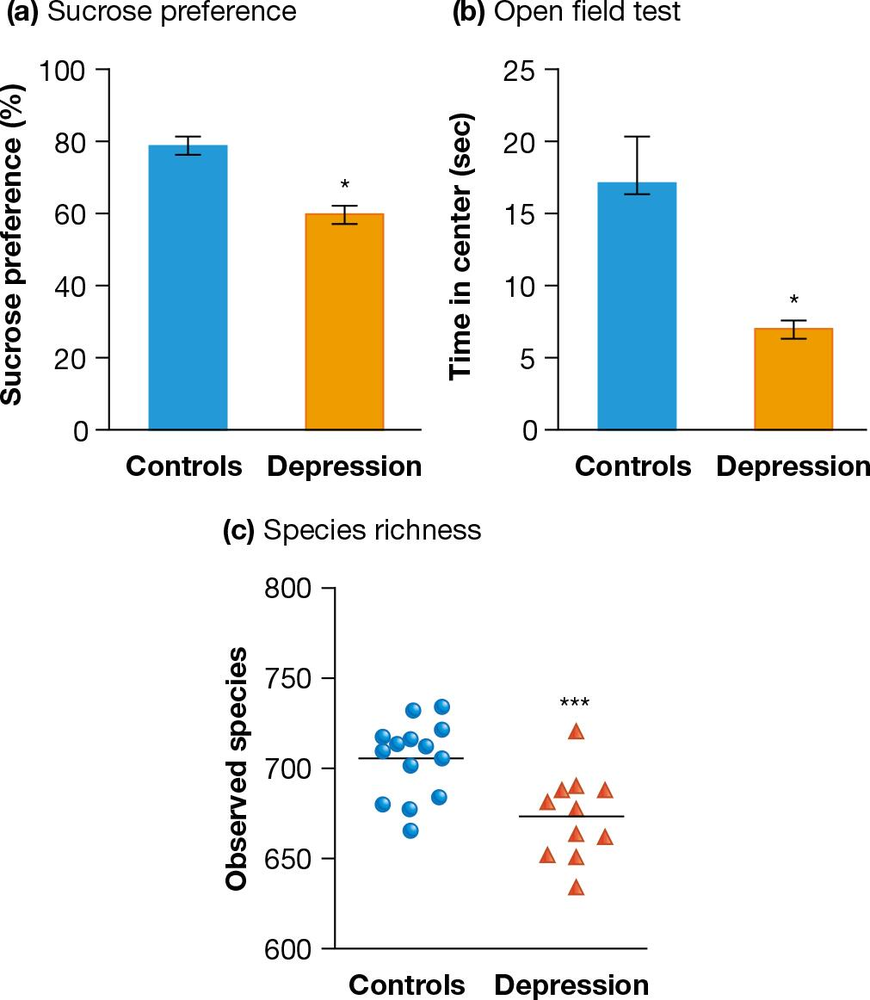
Patients from the depression group had relatively high levels of bacteria in the genus Paraprevotella (a Gram-negative bacterium) relative to the control group of patients. Which of the following is a structural difference between Paraprevotella and methicillin-resistant Staphylococcus aureus (MRSA), a Gram-positive bacterium?
a. Paraprevotella contains a thick layer of peptidoglycan in its cell wall and MRSA lacks peptidoglycan.
b. The plasma membrane of Paraprevotella is surrounded by a cell wall that contains a relatively thin layer of peptidoglycan and an outer membrane and MRSA cells are surrounded by cell walls with a relatively thick layer of peptidoglycan,
c. Paraprevotella produces endospores but MRSA does not.
d. Paraprevotella lacks a plasma membrane but MRSA cells are surrounded by two plasma membranes.
 Verified step by step guidance
1
Identify the key structural differences between Gram-negative and Gram-positive bacteria.
Recall that Paraprevotella is a Gram-negative bacterium and MRSA is a Gram-positive bacterium.
Understand that Gram-negative bacteria have a thin layer of peptidoglycan and an outer membrane, while Gram-positive bacteria have a thick layer of peptidoglycan and no outer membrane.
Analyze the provided options to determine which one correctly describes the structural differences between Paraprevotella and MRSA.
Select the option that states Paraprevotella has a thin layer of peptidoglycan and an outer membrane, while MRSA has a thick layer of peptidoglycan.
Key Concepts
Here are the essential concepts you must grasp in order to answer the question correctly.
Gut Microbiome
The gut microbiome refers to the diverse community of microorganisms residing in the gastrointestinal tract. These microbes play a crucial role in digestion, metabolism, and immune function, and emerging research suggests they may also influence mental health and behavior. Changes in the composition of gut microbiota have been linked to various psychological conditions, including depression and anxiety.
Recommended video:
 03:25
03:25
The Human Microbiome
Gram Staining and Bacterial Classification
Gram staining is a laboratory technique used to classify bacteria into two groups: Gram-positive and Gram-negative. This classification is based on the structure of their cell walls, where Gram-positive bacteria have a thick peptidoglycan layer, while Gram-negative bacteria possess a thin peptidoglycan layer and an outer membrane. Understanding these differences is essential for identifying bacterial species and their potential pathogenicity.
Recommended video:
 02:20
02:20Gram-Positive & Gram-Negative Bacteria
Fecal Microbiota Transfer (FMT)
Fecal microbiota transfer (FMT) is a medical procedure that involves transferring fecal matter from a healthy donor to a recipient to restore a balanced gut microbiome. This technique has shown promise in treating conditions like Clostridium difficile infection and is being explored for its potential effects on mental health. FMT can alter the microbial composition in the recipient, which may influence behavior and mood.
Recommended video:
 04:42
04:42Horizontal Gene Transfer
Related Practice