
Pearson+ LogoPearson+ Logo
Ch. 35 - Water and Sugar Transport in Plants
Freeman - Biological Science 8th Edition
Freeman8th EditionBiological ScienceISBN: 9780138276263Not the one you use?Change textbook
Chapter 35, Problem 7

A mutant plant lacking the ability to pump protons out of leaf companion cells will be unable to do which of the following?
a. Initiate transpiration
b. Load sucrose into sieve-tube elements
c. Carry out photosynthesis
d. Transport water through the xylem

Verified step by step guidance
1
Understand the role of proton pumps in plant cells: Proton pumps are responsible for creating a proton gradient across the cell membrane by actively transporting protons (H⁺ ions) out of the cell.
Recognize the function of companion cells: In plants, companion cells are closely associated with sieve-tube elements in the phloem and are crucial for the loading of sucrose into these elements.
Connect the proton pump activity to sucrose loading: The proton gradient established by the proton pumps is used to drive the active transport of sucrose into the sieve-tube elements through a process called cotransport.
Identify the consequence of lacking proton pumps: Without the ability to pump protons out of the companion cells, the plant cannot establish the necessary proton gradient, which is essential for the cotransport of sucrose.
Conclude which process is affected: Since the loading of sucrose into sieve-tube elements relies on the proton gradient, a mutant plant lacking proton pumps will be unable to load sucrose into sieve-tube elements, making option b the correct answer.

Verified video answer for a similar problem:

This video solution was recommended by our tutors as helpful for the problem above.
Video duration:
1m
Was this helpful?

Key Concepts

Here are the essential concepts you must grasp in order to answer the question correctly.

Proton Pump Function in Plant Cells

Proton pumps in plant cells are crucial for maintaining ion gradients across cell membranes. By actively transporting protons (H+) out of cells, they create an electrochemical gradient that facilitates the transport of other molecules, such as sucrose, into cells through secondary active transport mechanisms. This process is essential for various cellular functions, including nutrient loading and energy balance.
Recommended video:
Guided course
05:33
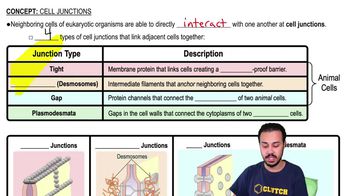
Cell Junctions

Sucrose Loading in Sieve-Tube Elements

Sucrose loading into sieve-tube elements is a vital step in phloem transport, where sugars produced during photosynthesis are distributed throughout the plant. This process relies on the proton gradient established by proton pumps, enabling sucrose to be co-transported into companion cells and then into sieve-tube elements. Without this gradient, sucrose cannot be efficiently loaded, disrupting nutrient distribution.
Recommended video:
Guided course
06:58
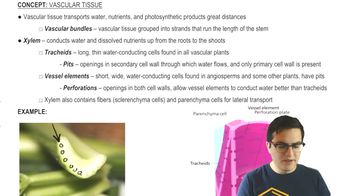
Vascular Tissue

Transpiration and Water Transport in Plants

Transpiration is the process of water movement through a plant and its evaporation from aerial parts, primarily leaves. It drives the upward transport of water and minerals from roots to leaves via the xylem. While proton pumps are not directly involved in transpiration, they play a role in maintaining cellular homeostasis, which indirectly supports overall plant water transport and nutrient distribution.
Recommended video:
Guided course
08:29
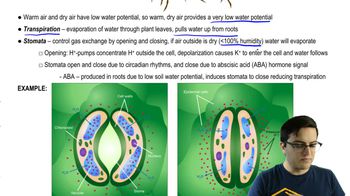
Water Potential in Soil and Air
Related Practice
Textbook Question

Consider the following statements regarding the transport of phloem sap. Select True or False for each statement.

T/F This is a passive process that is driven by the evaporation of water from leaves.

T/F Sugars tend to move from sources to sinks.

T/F Phloem sap moves through sieve-tube elements under positive pressure.

T/F Sieve-tube elements and vessel elements are commonly involved in the transport of phloem sap.

784
views
Textbook Question

The cells of a certain plant species can accumulate solutes to create very low solute potentials. Which of these statements is correct?

a. The plant's transpiration rates will tend to be extremely low.

b. The plant can compete for water effectively and live in relatively dry soils.

c. The plant will grow most effectively in soils that are saturated with water year-round.

d. The plant's leaves will wilt easily.

597
views
Textbook Question

Draw a plant cell in pure water. Add dots to indicate solutes inside the cell. Now add more dots to indicate an increase in solute potential inside the cell. Add an arrow showing the net direction of water movement in response. Add arrows showing the direction of wall pressure and turgor pressure in response to water movement. Repeat the same exercise, but this time, add solutes to the solution outside the cell at a concentration that is greater than inside the cell.

948
views
Textbook Question

Your friend claims that phloem always carries sugars down a plant. What, if anything, is wrong with that statement?

837
views
Textbook Question

Consider a tree that is 50 m tall and is transpiring roughly 90 liters of water each day. Approximately how many calories will the tree use to transpire this quantity of water?

928
views
Textbook Question

Salt is used to melt snow and keep roads clear during the winter in many cities. Land adjacent to de-iced roads often ends up with a high concentration of salt in the soil. Explain why plants growing near salted roads may appear wilted in the spring.

719
views