

Pearson+ LogoPearson+ Logo
Ch. 35 - Water and Sugar Transport in Plants
Freeman - Biological Science 8th Edition
Freeman8th EditionBiological ScienceISBN: 9780138276263Not the one you use?Change textbook
Chapter 35, Problem 4

Consider the following statements regarding the transport of phloem sap. Select True or False for each statement.
T/F This is a passive process that is driven by the evaporation of water from leaves.
T/F Sugars tend to move from sources to sinks.
T/F Phloem sap moves through sieve-tube elements under positive pressure.
T/F Sieve-tube elements and vessel elements are commonly involved in the transport of phloem sap.

Verified step by step guidance
1
Understand that phloem transport is primarily an active process, not passive. It involves the movement of sugars and other organic nutrients from sources (like leaves) to sinks (such as roots or fruits). This process is driven by pressure flow, not by the evaporation of water, which is a characteristic of xylem transport.
Recognize that sugars indeed move from sources to sinks. Sources are parts of the plant that produce or release sugars, while sinks are parts that consume or store sugars. This movement is facilitated by the pressure flow mechanism in the phloem.
Phloem sap moves through sieve-tube elements under positive pressure. This is known as the pressure flow hypothesis or mass flow hypothesis, where the loading of sugars into the phloem creates a high osmotic pressure that drives the flow towards areas of lower pressure.
Sieve-tube elements are specialized cells in the phloem that facilitate the transport of phloem sap. Vessel elements, on the other hand, are part of the xylem and are involved in water transport, not phloem sap transport. Therefore, they are not commonly involved in the transport of phloem sap.
Review the role of companion cells, which are closely associated with sieve-tube elements. They assist in the loading and unloading of sugars into the phloem, playing a crucial role in the active transport process.

Verified video answer for a similar problem:

This video solution was recommended by our tutors as helpful for the problem above.
Video duration:
4m
Was this helpful?

Key Concepts

Here are the essential concepts you must grasp in order to answer the question correctly.

Phloem Transport Mechanism

Phloem transport, also known as translocation, is the process of moving sugars and other organic nutrients through the plant. Unlike xylem transport, which is driven by negative pressure from water evaporation, phloem transport is an active process driven by positive pressure. This pressure is generated by the loading of sugars into the phloem at source sites, such as leaves, and unloading at sink sites, like roots or fruits.
Recommended video:
Guided course
02:37
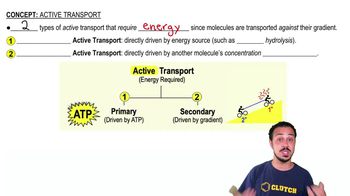
Active Transport

Source and Sink Dynamics

In plants, 'sources' are the parts that produce or release sugars, typically the leaves, while 'sinks' are the parts that consume or store sugars, such as roots, fruits, and growing tissues. Sugars move from sources to sinks through the phloem, driven by pressure differences. This movement is crucial for distributing energy and nutrients throughout the plant, supporting growth and development.
Recommended video:
Guided course
03:37
Disturbances Make Communities Dynamic

Sieve-Tube Elements

Sieve-tube elements are specialized cells in the phloem that facilitate the transport of phloem sap. They are elongated cells connected end-to-end, forming a continuous channel. Unlike vessel elements in the xylem, sieve-tube elements are alive at maturity and lack a nucleus, relying on companion cells for metabolic functions. Phloem sap moves through these tubes under positive pressure, a process distinct from the passive transport in xylem.
Recommended video:
Guided course
03:36
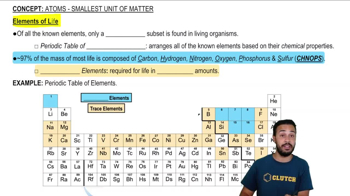
Elements of Life
Related Practice
Textbook Question

A cell is placed in a solution that is hypotonic to the cell. Which of the following best describes movement of water in this situation?

a. Water will only flow into the cell.

b. Water will only flow out of the cell.

c. Water will flow into and out of the cell, but the overall net movement will be out of the cell.

d. Water will flow into and out of the cell, but the overall net movement will be into the cell.

1953
views
Textbook Question

What important role does the Casparian strip play in the movement of water through plants?

a. Forces water to move through the cytoplasm of living endodermal cells as it makes its way from the soil to the xylem

b. Causes cells to shrink, thereby increasing pressure within cells

c. Loads sugars into xylem, thereby causing water to enter the xylem by osmosis

d. Acts as a filter that prevents salts, heavy metals, and other pollutants from entering root hairs

2187
views
Textbook Question

What is the role of companion cells in the movement of sugars through plants?

a. They are the sites of sugar production by photosynthesis.

d. They are the sites where starch is converted to sucrose.

c. They secrete sucrose, which draws sugars through phloem under negative pressure.

d. They accumulate sucrose, which is then transferred to adjacent sieve-tube elements.

911
views
Textbook Question

The cells of a certain plant species can accumulate solutes to create very low solute potentials. Which of these statements is correct?

a. The plant's transpiration rates will tend to be extremely low.

b. The plant can compete for water effectively and live in relatively dry soils.

c. The plant will grow most effectively in soils that are saturated with water year-round.

d. The plant's leaves will wilt easily.

597
views
Textbook Question

Draw a plant cell in pure water. Add dots to indicate solutes inside the cell. Now add more dots to indicate an increase in solute potential inside the cell. Add an arrow showing the net direction of water movement in response. Add arrows showing the direction of wall pressure and turgor pressure in response to water movement. Repeat the same exercise, but this time, add solutes to the solution outside the cell at a concentration that is greater than inside the cell.

948
views
Textbook Question

A mutant plant lacking the ability to pump protons out of leaf companion cells will be unable to do which of the following?

a. Initiate transpiration

b. Load sucrose into sieve-tube elements

c. Carry out photosynthesis

d. Transport water through the xylem

707
views