
Pearson+ LogoPearson+ Logo
Ch.4 - Nucleic Acids and the RNA World
Freeman - Biological Science 8th Edition
Freeman8th EditionBiological ScienceISBN: 9780138276263Not the one you use?Change textbook
Chapter 4, Problem 9

Make a concept map that relates DNA's primary structure to its secondary structure. Your diagram should include deoxyribonucleotides, base-stacking interactions, purines, pyrimidines, phosphodiester linkages, DNA's primary structure, DNA's secondary structure, complementary base pairing, and antiparallel double helix.

Verified step by step guidance
1
Start by defining DNA's primary structure, which is the linear sequence of deoxyribonucleotides linked by phosphodiester bonds. These bonds form between the 3' hydroxyl group of one nucleotide and the 5' phosphate group of the next.
Identify the components of deoxyribonucleotides: a deoxyribose sugar, a phosphate group, and a nitrogenous base. The nitrogenous bases are categorized into purines (adenine and guanine) and pyrimidines (cytosine and thymine).
Explain complementary base pairing, where adenine pairs with thymine via two hydrogen bonds, and guanine pairs with cytosine via three hydrogen bonds. This pairing is crucial for the formation of DNA's secondary structure.
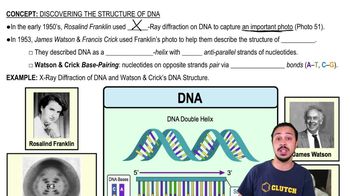
Describe DNA's secondary structure as an antiparallel double helix. The two strands run in opposite directions (5' to 3' and 3' to 5'), and the helical structure is stabilized by base-stacking interactions and hydrogen bonds between complementary bases.
Connect these concepts in a concept map: Start with DNA's primary structure at the center, branching out to deoxyribonucleotides and phosphodiester linkages. From deoxyribonucleotides, branch to purines and pyrimidines. Then, show how complementary base pairing and base-stacking interactions lead to the formation of the antiparallel double helix, representing DNA's secondary structure.

Verified video answer for a similar problem:

This video solution was recommended by our tutors as helpful for the problem above.
Video duration:
2m
Was this helpful?

Key Concepts

Here are the essential concepts you must grasp in order to answer the question correctly.

DNA Primary Structure

DNA's primary structure refers to the linear sequence of deoxyribonucleotides linked by phosphodiester bonds. Each nucleotide consists of a sugar, a phosphate group, and a nitrogenous base (either a purine or pyrimidine). The sequence of these bases encodes genetic information, and the order of nucleotides is crucial for DNA's function and replication.
Recommended video:
Guided course
04:41
Discovering the Structure of DNA

DNA Secondary Structure

The secondary structure of DNA is characterized by the formation of a double helix, where two strands of DNA run in opposite directions (antiparallel) and are held together by hydrogen bonds between complementary bases. Base-stacking interactions between adjacent bases on the same strand also contribute to the stability of the helix. This structure is essential for DNA's ability to store and transmit genetic information.
Recommended video:
Guided course
04:41
Discovering the Structure of DNA

Complementary Base Pairing

Complementary base pairing is a fundamental principle of DNA structure where adenine (a purine) pairs with thymine (a pyrimidine) and guanine (a purine) pairs with cytosine (a pyrimidine) through hydrogen bonds. This specificity ensures accurate replication and transcription of genetic information, as each base on one strand dictates the corresponding base on the opposite strand.
Recommended video: