Pearson+ LogoPearson+ Logo
Ch.4 - Nucleic Acids and the RNA World
Freeman - Biological Science 8th Edition
Freeman8th EditionBiological ScienceISBN: 9780138276263Not the one you use?Change textbook
Chapter 4, Problem 7

What would be the sequence of the strand of DNA that is made from the following template: 5′-GATATCGAT-3′? (Your answer must be written 5'→3'.) How would the sequence be different if RNA were made from this DNA template?

Verified step by step guidance
1
Step 1: Understand the basics of DNA replication. DNA replication is a process where a double-stranded DNA molecule is copied to produce two identical DNA molecules. DNA is made up of four types of nitrogen bases: Adenine (A), Thymine (T), Guanine (G), and Cytosine (C). In DNA, Adenine pairs with Thymine and Guanine pairs with Cytosine.
Step 2: Apply the base pairing rules to the given DNA template. The given DNA template is 5′-GATATCGAT-3′. According to the base pairing rules, the sequence of the new DNA strand would be 5′-CTATAGCTA-3′. This is because G pairs with C, A pairs with T, T pairs with A, C pairs with G, and so on.
Step 3: Understand the basics of transcription. Transcription is the process by which the information in a strand of DNA is copied into a new molecule of messenger RNA (mRNA). In RNA, Thymine is replaced by Uracil (U). So, Adenine pairs with Uracil in RNA.
Step 4: Apply the base pairing rules to the given DNA template for RNA. The given DNA template is 5′-GATATCGAT-3′. According to the base pairing rules for RNA, the sequence of the new RNA strand would be 5′-CUAUAGCUA-3′. This is because G pairs with C, A pairs with U, T pairs with A, C pairs with G, and so on.
Step 5: Compare the sequences of the new DNA and RNA strands. The sequence of the new DNA strand is 5′-CTATAGCTA-3′ and the sequence of the new RNA strand is 5′-CUAUAGCUA-3′. The sequences are the same except for the replacement of Thymine (T) by Uracil (U) in RNA.

Verified video answer for a similar problem:

This video solution was recommended by our tutors as helpful for the problem above.
Video duration:
5m
Was this helpful?

Key Concepts

Here are the essential concepts you must grasp in order to answer the question correctly.

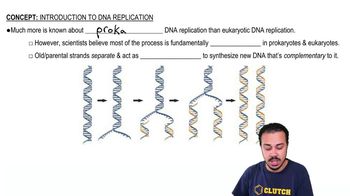
DNA Replication

DNA replication is the process by which a cell duplicates its DNA before cell division. During this process, the DNA strands separate, and new complementary strands are synthesized based on the original template strands. The base pairing rules dictate that adenine pairs with thymine, and cytosine pairs with guanine, which is essential for accurately copying the genetic information.
Recommended video:
Guided course
03:37
Introduction to DNA Replication

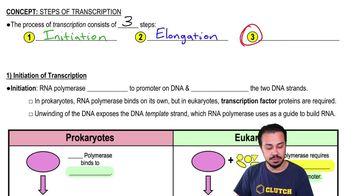
Transcription

Transcription is the process by which the genetic information in DNA is copied into RNA. During transcription, RNA polymerase binds to the DNA template strand and synthesizes a complementary RNA strand. Unlike DNA, RNA uses uracil instead of thymine, which means adenine in the DNA pairs with uracil in the RNA, leading to a different sequence when RNA is produced from a DNA template.
Recommended video:
Guided course
04:16
1) Initiation of Transcription

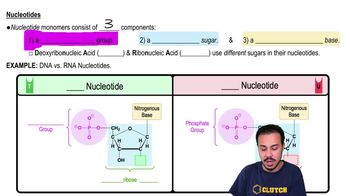
Nucleotide Base Pairing

Nucleotide base pairing is the specific pairing of nitrogenous bases in nucleic acids, which is crucial for the structure and function of DNA and RNA. In DNA, adenine pairs with thymine and cytosine pairs with guanine, while in RNA, adenine pairs with uracil instead of thymine. Understanding these pairing rules is essential for determining the complementary sequences during DNA replication and RNA transcription.
Recommended video: