
In 2023, Tigist Assefa of Ethiopia set a new record with a time of 2 hours, 11 minutes, and 53 seconds. Scientists, trainers, and athletes alike have wondered about the extent to which muscle structure and function contribute to success in athletes such as Assefa. What makes elite distance runners so good? Are their muscles somehow different from those of less successful athletes and non-athletes? To discover the relationship between muscle-fiber types and performance, researchers obtained tiny biopsies of the gastrocnemius of 14 elite distance runners, 18 trained but non-elite distance runners, and 19 untrained subjects. They categorized the fiber types as slow or fast. (At the time of the study, intermediate fibers had not been identified as a third type.) Some of their data are shown here (* means 𝑃<0.05; BioSkills 3). What conclusions can you draw from these data?

- Ch. 1 - Biology: The Study of Life13
- Ch. 2 - Water and Carbon: The Chemical Basis of Life14
- Ch.3 - Protein Structure and Function10
- Ch.4 - Nucleic Acids and the RNA World10
- Ch. 5 - An Introduction to Carbohydrates10
- Ch. 6 - Lipids, Membranes, and the First Cells11
- Ch. 7 - Inside the Cell10
- Ch. 8 - Energy and Enzymes: An Introduction to Metabolism10
- Ch. 9 - Cellular Respiration and Fermentation11
- Ch. 10 - Photosynthesis12
- Ch. 11 - Cell-Cell Interactions12
- Ch. 12 - The Cell Cycle8
- Ch. 13 - Meiosis12
- Ch. 14 - Mendel and the Gene23
- Ch. 15 - DNA and the Gene: Synthesis and Repair15
- Ch. 16 - How Genes Work16
- Ch. 17 - Transcription, RNA Processing, and Translation16
- Ch. 18 - Control of Gene Expression in Bacteria16
- Ch. 19 - Control of Gene Expression in Eukaryotes12
- Ch. 20 - The Molecular Revolution: Biotechnology, Genomics, and New Frontiers15
- Ch. 21 - Genes, Development, and Evolution12
- Ch. 22 - Evolution by Natural Selection16
- Ch. 23 - Evolutionary Processes13
- Ch. 24 - Speciation15
- Ch. 25 - Phylogenies and the History of Life13
- Ch. 26 - Bacteria and Archaea15
- Ch. 27 - Diversification of Eukaryotes16
- Ch. 28 - Green Algae and Land Plants16
- Ch. 29 - Fungi18
- Ch. 30 - An Introduction to Animals9
- Ch. 31 - Protostome Animals15
- Ch. 32 - Deuterostome Animals17
- Ch. 33 - Viruses16
- Ch. 34 - Plant Form and Function16
- Ch. 35 - Water and Sugar Transport in Plants16
- Ch. 36 - Plant Nutrition13
- Ch. 37 - Plant Sensory Systems, Signals, and Responses16
- Ch. 38 - Flowering Plant Reproduction and Development16
- Ch. 39 - Animal Form and Function17
- Ch. 40 - Water and Electrolyte Balance in Animals16
- Ch. 41 - Animal Nutrition16
- Ch. 42 - Gas Exchange and Circulation16
- Ch. 43 - Animal Nervous Systems16
- Ch. 44 - Animal Sensory Systems16
- Ch. 45 - Animal Movement11
- Ch. 46 - Chemical Signals in Animals16
- Ch. 47 - Animal Reproduction and Development16
- Ch. 48 - The Immune System in Animals16
- Ch. 49 - An Introduction to Ecology15
- Ch. 50 - Behavioral Ecology16
- Ch. 51 - Population Ecology16
- Ch. 52 - Community Ecology20
- Ch. 53 - Ecosystems and Global Ecology17
- Ch. 54 - Biodiversity and Conservation Ecology18
In 2023, Tigist Assefa of Ethiopia set a new record with a time of 2 hours, 11 minutes, and 53 seconds. Scientists, trainers, and athletes alike have wondered about the extent to which muscle structure and function contribute to success in athletes such as Assefa. What makes elite distance runners so good? Are their muscles somehow different from those of less successful athletes and non-athletes? Imagine that Tigist Assefa is racing against a bird and a fish, each with the same mass as Assefa. Which organism would have the highest cost of locomotion during the race?
 Verified step by step guidance
Verified video answer for a similar problem:

Key Concepts
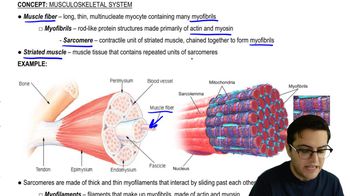
Muscle Fiber Types
 02:40
02:40
Cost of Locomotion
 02:08
02:08Biomechanics of Locomotion
02:08In 2023, Tigist Assefa of Ethiopia set a new record with a time of 2 hours, 11 minutes, and 53 seconds. Scientists, trainers, and athletes alike have wondered about the extent to which muscle structure and function contribute to success in athletes such as Assefa. What makes elite distance runners so good? Are their muscles somehow different from those of less successful athletes and non-athletes? The researchers looked more closely at the data within the group of elite runners. Although the mean proportion of slow fibers was 79 percent in this group, individual values ranged from 27 percent in one runner to 98 percent in another. How does this finding affect your interpretation of the relationship between athletic performance and muscle-fiber types?
In 2023, Tigist Assefa of Ethiopia set a new record with a time of 2 hours, 11 minutes, and 53 seconds. Scientists, trainers, and athletes alike have wondered about the extent to which muscle structure and function contribute to success in athletes such as Assefa. What makes elite distance runners so good? Are their muscles somehow different from those of less successful athletes and non-athletes? Predict the effect of training for a marathon on the number of muscle cells in the gastrocnemius. Explain.