Pearson+ LogoPearson+ Logo
Ch. 48 - The Immune System in Animals
Freeman - Biological Science 8th Edition
Freeman8th EditionBiological ScienceISBN: 9780138276263Not the one you use?Change textbook
Chapter 48, Problem 6

What steps are required for most B cells to become fully activated and differentiate into plasma cells?

Verified step by step guidance
1
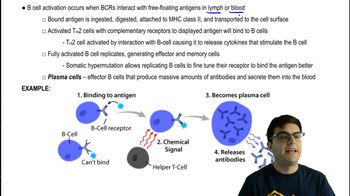
Step 1: Antigen Recognition - B cells recognize specific antigens through their B cell receptors (BCRs). The BCRs bind to antigens that match their specific shape, initiating the activation process.
Step 2: Antigen Processing and Presentation - After binding, the B cell internalizes the antigen and processes it into smaller peptides. These peptides are then presented on the surface of the B cell bound to MHC class II molecules.
Step 3: T Helper Cell Interaction - The processed antigens presented on the B cell surface are recognized by T helper cells (specifically, Th2 cells). The T helper cells bind to the antigen-MHC II complex through their T cell receptors (TCRs).
Step 4: Co-stimulatory Signals and Cytokine Secretion - The interaction between the B cell and T helper cell leads to the delivery of co-stimulatory signals. T helper cells also secrete cytokines such as IL-4 and IL-5, which are crucial for B cell proliferation and differentiation.
Step 5: Differentiation into Plasma Cells - With signals from both the antigen binding and T helper cells, B cells undergo proliferation and differentiation into plasma cells. Plasma cells are specialized for producing and secreting large amounts of antibodies specific to the antigen.

Verified video answer for a similar problem:

This video solution was recommended by our tutors as helpful for the problem above.
Video duration:
1m
Was this helpful?

Key Concepts

Here are the essential concepts you must grasp in order to answer the question correctly.

B Cell Activation

B cell activation is the process by which naive B cells recognize specific antigens through their B cell receptors (BCRs). This recognition is often enhanced by the presence of helper T cells, which provide necessary signals through cytokines and direct cell-to-cell interactions. The initial activation leads to clonal expansion, where activated B cells proliferate and prepare for differentiation.
Recommended video:
Guided course
04:06
Helper T Cells and B Cells

Role of T Helper Cells

T helper cells, particularly CD4+ T cells, play a crucial role in B cell activation. Upon recognizing an antigen presented by antigen-presenting cells (APCs), T helper cells release cytokines that stimulate B cells. This interaction is essential for the full activation of B cells, leading to their differentiation into plasma cells that produce antibodies.
Recommended video:
Guided course
04:06
Helper T Cells and B Cells

Differentiation into Plasma Cells

Differentiation into plasma cells is the final step in the B cell response, where activated B cells transform into antibody-secreting cells. This process is driven by signals from T helper cells and involves changes in gene expression that enable the production of large quantities of antibodies. Plasma cells are critical for the adaptive immune response, providing long-lasting immunity against specific pathogens.
Recommended video:
Guided course
05:28
Cell Division and Differentiation
Related Practice
Textbook Question

What is the difference between an epitope and an antigen?

1301
views
Textbook Question

What is one of the differences between CD4+ and CD8+ T cells?

a. CD4+ cells are immature, and CD8+ cells are mature.

b. CD4+ cells are activated, and CD8+ cells are not.

c. CD4+ cells interact with class II MHC proteins, and CD8+ cells interact with class I MHC proteins.

d. CD4+ cells activate cell-mediated responses, and CD8+ cells activate humoral responses.

1937
views
Textbook Question

Explain how gene recombination leads to the production of vast numbers of different B-cell receptors.

712
views
Textbook Question

Why is clonal selection necessary for the adaptive immune response but not the innate immune response? Select True or False for each statement.

T/F The adaptive immune response uses receptors to recognize pathogens, and the innate immune response does not.

T/F There is more receptor diversity in the adaptive immune response than in the innate immune response.

T/F Cells in the innate immune response do not require activation, and those in the adaptive immune response do.

T/F Clonal selection is used for targeting pathogens, and the innate immune response is used only to stop blood flow from the wound.

1079
views
Textbook Question

What would a vaccine have to contain to protect a patient from chicken pox? Explain why we don't have vaccines for HIV.

813
views
Textbook Question

Which of the following outcomes would be expected if somatic hypermutation did not occur?

a. The diversity of pattern-recognition receptors would be significantly lowered.

b. B and T lymphocytes would not be able to produce receptors that recognize antigens.

c. The adaptive immune response would not be activated by pathogens.

d. The secondary immune response to a repeat infection would produce the same antibodies as those made in the primary immune response.

715
views