Pearson+ LogoPearson+ Logo
Ch. 48 - The Immune System in Animals
Freeman - Biological Science 8th Edition
Freeman8th EditionBiological ScienceISBN: 9780138276263Not the one you use?Change textbook
Chapter 48, Problem 9

Which of the following outcomes would be expected if somatic hypermutation did not occur?
a. The diversity of pattern-recognition receptors would be significantly lowered.
b. B and T lymphocytes would not be able to produce receptors that recognize antigens.
c. The adaptive immune response would not be activated by pathogens.
d. The secondary immune response to a repeat infection would produce the same antibodies as those made in the primary immune response.

Verified step by step guidance
1
Understand the role of somatic hypermutation: It is a process that occurs in B cells during an immune response, leading to the production of antibodies with increased affinity for their specific antigen.
Recognize that somatic hypermutation contributes to the diversity and specificity of antibodies, allowing the immune system to adapt and respond more effectively to pathogens.
Consider the options: a. Pattern-recognition receptors are part of the innate immune system and are not affected by somatic hypermutation, so this option is incorrect. b. B and T lymphocytes can still produce receptors without somatic hypermutation, but these receptors would not have increased affinity, so this option is incorrect. c. The adaptive immune response can still be activated without somatic hypermutation, but it would be less effective, so this option is incorrect.
Evaluate option d: Without somatic hypermutation, the secondary immune response would not produce antibodies with higher affinity than those produced in the primary response, leading to the same antibodies being produced.
Conclude that the correct outcome if somatic hypermutation did not occur is option d, as the secondary immune response would not improve in terms of antibody affinity compared to the primary response.

Verified video answer for a similar problem:

This video solution was recommended by our tutors as helpful for the problem above.
Video duration:
4m
Was this helpful?

Key Concepts

Here are the essential concepts you must grasp in order to answer the question correctly.

Somatic Hypermutation

Somatic hypermutation is a cellular mechanism in B cells that introduces mutations at a high rate in the variable regions of immunoglobulin genes. This process occurs after B cell activation and is crucial for the diversification of antibodies, allowing the immune system to adapt and improve its response to specific antigens over time.
Recommended video:
Guided course
04:06
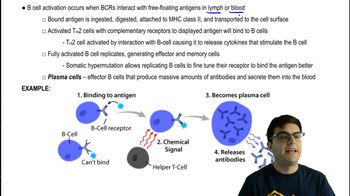
Helper T Cells and B Cells

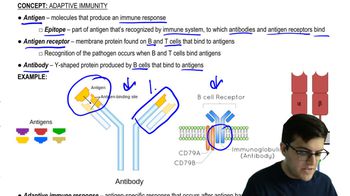
Adaptive Immune Response

The adaptive immune response is a highly specific defense mechanism that involves the activation of lymphocytes (B and T cells) in response to pathogens. It is characterized by its ability to remember past infections, leading to a more rapid and effective response upon re-exposure to the same pathogen, primarily through the production of specific antibodies and memory cells.
Recommended video:
Guided course
05:50
Adaptive Immune Response

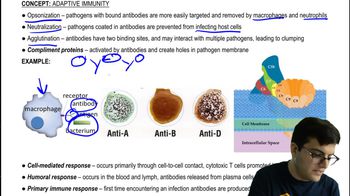
Secondary Immune Response

The secondary immune response is the immune system's reaction to a previously encountered antigen. It is faster and more robust than the primary response due to the presence of memory B and T cells. These cells quickly recognize the antigen and produce a more effective and higher affinity antibody response, often preventing reinfection or reducing the severity of the disease.
Recommended video:
Guided course
06:14
Primary and Secondary Immunity