Back
Back
Problem 8.PE.38
Evaluate the integrals in Exercises 37–44.
∫ cos⁵(x) sin⁵(x) dx
Problem 8.PE.79
Evaluate the integrals in Exercises 69–134. The integrals are listed in random order so you need to decide which integration technique to use.
∫ (x + 1) / (x⁴ − x³) dx
Problem 8.PE.16
Evaluate the integrals in Exercises 9–28. It may be necessary to use a substitution first.
∫ [(4x) / (x³ + 4x)] dx
Problem 8.PE.55
Evaluate the improper integrals in Exercises 53–62.
∫ from 0 to 2 of (1 / (y − 1)^(2/3)) dy
Problem 8.PE.135
135. Evaluate ∫₀^(π/2) (sin x) / (sin x + cos x) dx in two ways:
(a) By evaluating ∫ (sin x) / (sin x + cos x) dx, then using the Evaluation Theorem.
Problem 8.QGYR.4
4. What substitutions are made to evaluate integrals of sin(mx)sin(nx), sin(mx)cos(nx), and cos(mx)cos(nx)? Give an example of each case.
Problem 8.7.20a
In Exercises 11–22, estimate the minimum number of subintervals needed to approximate the integrals with an error of magnitude less than 10^-4 by (a) the Trapezoidal Rule (The integrals in Exercises 11–18 are the integrals from Exercises 1–8.)
∫ from 0 to 3 of 1/√(x + 1) dx
Problem 8.7.12a
In Exercises 11–22, estimate the minimum number of subintervals needed to approximate the integrals with an error of magnitude less than 10^-4 by (a) the Trapezoidal Rule (The integrals in Exercises 11–18 are the integrals from Exercises 1–8.)
∫ from 1 to 3 of (2x - 1) dx
Problem 8.4.61a
Evaluate ∫ x³ √(1 - x²) dx using:
a. Integration by parts.
Problem 8.2.62a
Finding volume: Find the volume of the solid generated by revolving the region bounded by the x-axis and the curve y = x sin(x), 0 ≤ x ≤ π, about
a. The y-axis.
(See Exercise 57 for a graph.)
Problem 8.5.74a
Evaluate ∫ sec θ dθ by:
a. Multiplying by (sec θ + tan θ) / (sec θ + tan θ) and then using a u-substitution.
Problem 8.2.63a
Consider the region bounded by the graphs of
y = ln(x), y = 0, and x = e.
a. Find the area of the region.
Problem 8.2.60a
Finding volume: Find the volume of the solid generated by revolving the region in the first quadrant bounded by the coordinate axes, the curve y = e^(-x), and the line x = 1.
a. About the y-axis.
Problem 8.7.14a
In Exercises 11–22, estimate the minimum number of subintervals needed to approximate the integrals with an error of magnitude less than 10^-4 by (a) the Trapezoidal Rule (The integrals in Exercises 11–18 are the integrals from Exercises 1–8.)
∫ from -2 to 0 of (x² - 1) dx
Problem 8.6.59a
Centroid:
Find the centroid of the region cut from the first quadrant by the curve
y = 1/√(x + 1) and the line x = 3.
Problem 8.7.13a
In Exercises 11–22, estimate the minimum number of subintervals needed to approximate the integrals with an error of magnitude less than 10^-4 by (a) the Trapezoidal Rule (The integrals in Exercises 11–18 are the integrals from Exercises 1–8.)
∫ from -1 to 1 of (x² + 1) dx
Problem 8.7.15a
In Exercises 11–22, estimate the minimum number of subintervals needed to approximate the integrals with an error of magnitude less than 10^-4 by (a) the Trapezoidal Rule (The integrals in Exercises 11–18 are the integrals from Exercises 1–8.)
∫ from 0 to 2 of (t³ + t) dt
Problem 8.1.54a
Using different substitutions
Show that the integral
∫((x² - 1)(x + 1))^(-2/3) dx
can be evaluated with any of the following substitutions.
a. u = 1/(x + 1)
What is the value of the integral?
Problem 8.7.21a
In Exercises 11–22, estimate the minimum number of subintervals needed to approximate the integrals with an error of magnitude less than 10^-4 by (a) the Trapezoidal Rule (The integrals in Exercises 11–18 are the integrals from Exercises 1–8.)
∫ from 0 to 2 of sin(x + 1) dx
Problem 8.8.88a
88. The region in Exercise 87 is revolved about the x-axis to generate a solid.
a. Find the volume of the solid.
Problem 8.7.17a
In Exercises 11–22, estimate the minimum number of subintervals needed to approximate the integrals with an error of magnitude less than 10^-4 by (a) the Trapezoidal Rule (The integrals in Exercises 11–18 are the integrals from Exercises 1–8.)
∫ from 1 to 2 of 1/s² ds
Problem 8.2.58a
Finding area
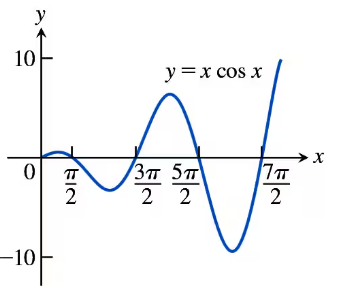
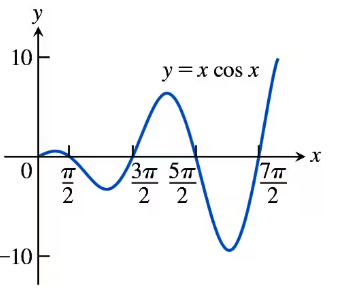
Find the area of the region enclosed by the curve y = x cos(x) and the x-axis (see the accompanying figure) for:
a. π/2 ≤ x ≤ 3π/2.
Problem 8.8.81a
81. Find the values of p for which each integral converges.
a. ∫ from 1 to 2 of [dx / (x (ln x)^p)]
Problem 8.7.18a
In Exercises 11–22, estimate the minimum number of subintervals needed to approximate the integrals with an error of magnitude less than 10^-4 by (a) the Trapezoidal Rule (The integrals in Exercises 11–18 are the integrals from Exercises 1–8.)
∫ from 2 to 4 of 1/(s - 1)² ds
Problem 8.9.42a
Lifetime of a tire Assume the random variable L in Example 2f is normally distributed with mean μ = 22,000 miles and σ = 4,000 miles.
a. In a batch of 4000 tires, how many can be expected to last for at least 18,000 miles?
Problem 8.7.16a
In Exercises 11–22, estimate the minimum number of subintervals needed to approximate the integrals with an error of magnitude less than 10^-4 by (a) the Trapezoidal Rule (The integrals in Exercises 11–18 are the integrals from Exercises 1–8.)
∫ from -1 to 1 of (t³ + 1) dt
Problem 8.4.59b
Consider the region bounded by the graphs of y = sin⁻¹(x), y = 0, and x = 1/2.
b. Find the centroid of the region.
Problem 8.7.21b
In Exercises 11–22, estimate the minimum number of subintervals needed to approximate the integrals with an error of magnitude less than 10^-4 by (b) Simpson’s Rule. (The integrals in Exercises 11–18 are the integrals from Exercises 1–8.)
∫ from 0 to 2 of sin(x + 1) dx
Problem 8.2.58b
Finding area
Find the area of the region enclosed by the curve y = x cos(x) and the x-axis (see the accompanying figure) for:
b. 3π/2 ≤ x ≤ 5π/2.
Problem 8.8.89b
89. Consider the infinite region in the first quadrant bounded by the graphs of
y = 1 / x², y = 0, and x = 1.
b. Find the volume of the solid formed by revolving the region (i) about the x-axis.