Ch.6 - Electronic Structure of Atoms
Chapter 6, Problem 43b

One of the emission lines of the hydrogen atom has a wavelength of 94.974 nm. (b) Determine the initial and final values of n associated with this emission.

Verified step by step guidance
1
Identify the given wavelength of the emission line, which is 94.974 nm. Convert this wavelength into meters by multiplying by \$10^{-9}\(, as 1 nm = \)10^{-9}$ meters.
Use the Rydberg formula for hydrogen emission, which is given by \(\frac{1}{\lambda} = R_H \left( \frac{1}{n_1^2} - \frac{1}{n_2^2} \right)\), where \(\lambda\) is the wavelength, \(R_H\) is the Rydberg constant (approximately \$1.097 \times 10^7 \, \text{m}^{-1}\(), \)n_1\( is the lower energy level, and \)n_2$ is the higher energy level.
Calculate \(\frac{1}{\lambda}\) using the converted wavelength in meters to find the inverse wavelength in meters\(^{-1}\).
Rearrange the Rydberg formula to solve for \(\left( \frac{1}{n_1^2} - \frac{1}{n_2^2} \right)\) by dividing the inverse wavelength by the Rydberg constant.
Estimate possible values of \(n_1\) and \(n_2\) that satisfy the equation \(\left( \frac{1}{n_1^2} - \frac{1}{n_2^2} \right)\). Typically, \(n_1\) will be a smaller integer (like 1 or 2) and \(n_2\) will be a larger integer. Check different combinations of \(n_1\) and \(n_2\) to see which pair fits the calculated value from the previous step.

Verified video answer for a similar problem:

This video solution was recommended by our tutors as helpful for the problem above.
Video duration:
9m
Was this helpful?

Key Concepts

Here are the essential concepts you must grasp in order to answer the question correctly.

Hydrogen Emission Spectrum

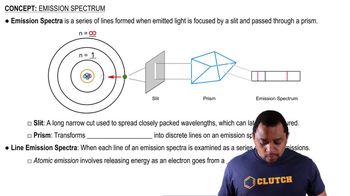
The hydrogen emission spectrum is a series of discrete wavelengths emitted by hydrogen atoms when electrons transition between energy levels. Each line in the spectrum corresponds to a specific transition, with the wavelength related to the energy difference between the initial and final states of the electron.
Recommended video:
Guided course
01:51
Emission Spectra

Energy Level Transitions

In an atom, electrons occupy quantized energy levels, denoted by the principal quantum number n. When an electron moves from a higher energy level (n_initial) to a lower one (n_final), it emits a photon with energy equal to the difference between these levels, which can be calculated using the Rydberg formula.
Recommended video:
Guided course
03:12
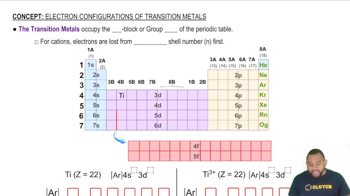
Transition Metals

Rydberg Formula

The Rydberg formula allows for the calculation of the wavelengths of spectral lines in hydrogen. It is expressed as 1/λ = R_H (1/n_final² - 1/n_initial²), where R_H is the Rydberg constant. This formula is essential for determining the initial and final quantum numbers associated with a given wavelength.
Recommended video:
Guided course
02:26
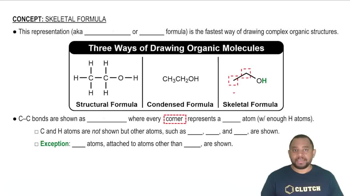
Skeletal Formula