
Determine whether each molecular diagram represents a pure substance or a mixture. If it represents a pure substance, classify the substance as an element or a compound. If it represents a mixture, classify the mixture as homogeneous or heterogeneous.
Ch.1 - Matter, Measurement & Problem Solving
Chapter 1, Problem 39
Complete the table. SUBSTANCE, PURE OR MIXTURE, TYPE aluminum, pure, element apple juice, ___, ___ hydrogen peroxide, ___, ___ chicken soup, ___, ___
Verified step by step guidance1
Identify the nature of each substance: Determine if each substance is a pure substance or a mixture.
For apple juice: Consider if it has a uniform composition and if it can be separated into different components.
For hydrogen peroxide: Determine if it is a single type of molecule or a combination of different substances.
For chicken soup: Analyze if it consists of multiple components that can be physically separated.
Classify each substance: Based on your analysis, classify apple juice, hydrogen peroxide, and chicken soup as either a pure substance or a mixture, and specify the type (element, compound, homogeneous mixture, or heterogeneous mixture).
Key Concepts
Here are the essential concepts you must grasp in order to answer the question correctly.
Pure Substances
A pure substance consists of a single type of particle and has a uniform composition throughout. Pure substances can be elements, which are made of only one kind of atom, or compounds, which are made of two or more types of atoms chemically bonded together. Examples include elements like aluminum and compounds like hydrogen peroxide.
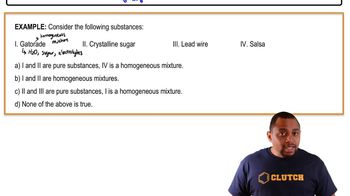
Recommended video:
Guided course
Classification of Matter Example
Mixtures
A mixture is a combination of two or more substances that retain their individual properties and can be separated by physical means. Mixtures can be homogeneous, where the composition is uniform (like apple juice), or heterogeneous, where the composition is not uniform (like chicken soup). Understanding the distinction helps in classifying substances correctly.
Classification of Matter
Matter can be classified into pure substances and mixtures based on its composition. This classification is essential for understanding chemical properties and behaviors. Elements and compounds fall under pure substances, while mixtures can be further categorized into homogeneous and heterogeneous types, aiding in the identification and analysis of various materials.
Recommended video:
Guided course
Classification of Matter Example
Related Practice
Textbook Question
3449
views
1
rank
Textbook Question
Classify each of the listed properties of ozone (a pollutant in the lower atmosphere but part of a protective shield against UV light in the upper atmosphere) as physical or chemical. a. bluish color b. pungent odor c. very reactive d. decomposes on exposure to ultraviolet light e. gas at room temperature
1085
views
Textbook Question
Classify each property as physical or chemical. a. the boiling point of ethyl alcohol b. the temperature at which dry ice evaporates c. the tendency of iron to rust d. the color of gold
622
views
Textbook Question
Classify each substance as a pure substance or a mixture. If it is a pure substance, classify it as an element or a compound. If it is a mixture, classify it as homogeneous or heterogeneous. a. sweat b. carbon dioxide c. aluminum d. vegetable soup
2914
views
