How do covalent bonds differ from hydrogen bonds? Define base complementarity.
Verified step by step guidance
1
Start by defining covalent bonds: these are strong chemical bonds formed when two atoms share one or more pairs of electrons, creating a stable connection between them.
Next, define hydrogen bonds: these are weaker, non-covalent interactions that occur when a hydrogen atom covalently bonded to an electronegative atom (like oxygen or nitrogen) is attracted to another electronegative atom nearby.
Explain the key difference: covalent bonds involve sharing electrons to form a strong, stable bond within molecules, while hydrogen bonds are weaker attractions between molecules or different parts of a molecule, important for molecular structure and interactions.
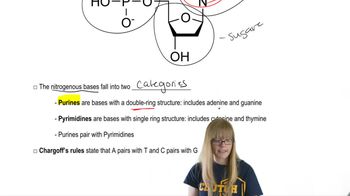
Define base complementarity in genetics: it refers to the specific pairing between nucleotide bases in DNA or RNA, where adenine (A) pairs with thymine (T) in DNA (or uracil (U) in RNA), and cytosine (C) pairs with guanine (G), primarily through hydrogen bonding.
Highlight the importance of base complementarity: it ensures accurate DNA replication and proper RNA transcription by maintaining the specific pairing rules that allow genetic information to be copied and expressed correctly.
Verified video answer for a similar problem:
This video solution was recommended by our tutors as helpful for the problem above
Video duration:
2m
Play a video:
Was this helpful?
Key Concepts
Here are the essential concepts you must grasp in order to answer the question correctly.
Covalent Bonds
Covalent bonds are strong chemical bonds formed when two atoms share one or more pairs of electrons. These bonds create stable molecules by holding atoms tightly together, such as the sugar-phosphate backbone in DNA.
Hydrogen bonds are weaker, non-covalent interactions that occur when a hydrogen atom covalently bonded to an electronegative atom (like oxygen or nitrogen) is attracted to another electronegative atom. In DNA, hydrogen bonds connect complementary bases between strands.
Base complementarity refers to the specific pairing between nucleotide bases in DNA: adenine pairs with thymine via two hydrogen bonds, and cytosine pairs with guanine via three hydrogen bonds. This specificity ensures accurate DNA replication and stable double helix formation.