Which of the following characteristics does NOT describe the triplet codon code?
Table of contents
- 1. Introduction to Genetics51m
- 2. Mendel's Laws of Inheritance3h 37m
- 3. Extensions to Mendelian Inheritance2h 41m
- 4. Genetic Mapping and Linkage2h 28m
- 5. Genetics of Bacteria and Viruses1h 21m
- 6. Chromosomal Variation1h 48m
- 7. DNA and Chromosome Structure56m
- 8. DNA Replication1h 10m
- 9. Mitosis and Meiosis1h 34m
- 10. Transcription1h 0m
- 11. Translation58m
- 12. Gene Regulation in Prokaryotes1h 19m
- 13. Gene Regulation in Eukaryotes44m
- 14. Genetic Control of Development44m
- 15. Genomes and Genomics1h 50m
- 16. Transposable Elements47m
- 17. Mutation, Repair, and Recombination1h 6m
- 18. Molecular Genetic Tools19m
- 19. Cancer Genetics29m
- 20. Quantitative Genetics1h 26m
- 21. Population Genetics50m
- 22. Evolutionary Genetics29m
11. Translation
The Genetic Code
Problem 1c
Textbook Question
How were the specific sequences of triplet codes determined experimentally?
Verified step by step guidance1
Understand that the specific sequences of triplet codes, or codons, were determined by experiments designed to link nucleotide sequences to amino acids in proteins.
Review the key experiment by Marshall Nirenberg and Heinrich Matthaei in 1961, where they used synthetic RNA sequences composed of repeating nucleotides (e.g., poly-U) to direct the synthesis of polypeptides in a cell-free system.
Recognize that by adding synthetic RNA sequences of known composition to a cell-free translation system, researchers observed which amino acids were incorporated into the resulting polypeptides, thus associating specific triplet sequences with particular amino acids.
Learn that by systematically testing different synthetic RNA sequences (e.g., poly-A, poly-C, and mixed sequences), scientists were able to assign amino acids to most of the 64 possible triplet codons.
Note that additional techniques, such as using trinucleotide binding assays and sequencing of tRNA anticodons, helped confirm and refine the assignments of codons to amino acids.
Verified video answer for a similar problem:This video solution was recommended by our tutors as helpful for the problem above
Video duration:
1mPlay a video:
Was this helpful?
Key Concepts
Here are the essential concepts you must grasp in order to answer the question correctly.
Triplet Code in Genetic Coding
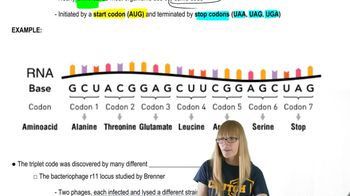
The triplet code refers to the sequence of three nucleotides (codons) in DNA or RNA that specify a single amino acid during protein synthesis. Understanding this code is fundamental to decoding how genetic information translates into proteins.
Recommended video:
Guided course
The Genetic Code
Experimental Methods for Deciphering the Genetic Code
Early experiments, such as those by Nirenberg and Matthaei, used synthetic RNA sequences to direct protein synthesis in vitro, allowing researchers to link specific triplet sequences to particular amino acids. This approach was key to identifying codon assignments.
Recommended video:
Guided course
The Genetic Code
Use of Cell-Free Systems and Synthetic RNA
Cell-free systems, which contain the molecular machinery for protein synthesis but lack intact cells, were used with synthetic RNA polymers to observe which amino acids were incorporated into proteins. This method enabled precise determination of codon meanings.
Recommended video:
Related Videos
Related Practice
Multiple Choice
777
views
6
rank