Pearson+ LogoPearson+ Logo
Ch. 11 - DNA Replication and Recombination
Klug - Concepts of Genetics  12th Edition
Klug12th EditionConcepts of Genetics ISBN: 9780135564776Not the one you use?Change textbook
Chapter 11, Problem 20a

Several temperature-sensitive mutant strains of E. coli display the following characteristics. Predict what enzyme or function is being affected by each mutation.
Newly synthesized DNA contains many mismatched base pairs.

Verified step by step guidance
1
Understand the problem: The question describes a temperature-sensitive mutant strain of E. coli where newly synthesized DNA contains many mismatched base pairs. This suggests a defect in a process that normally ensures DNA replication fidelity.
Recall the key enzymes and functions involved in DNA replication and repair: DNA polymerase synthesizes new DNA strands, but it also has proofreading activity to correct mismatches. Additionally, mismatch repair enzymes correct errors that escape proofreading.
Analyze the phenotype: Since many mismatched base pairs remain in the newly synthesized DNA, the mutation likely affects either the proofreading function of DNA polymerase or the mismatch repair system.
Identify the specific enzyme or function: The proofreading activity is typically associated with the 3' to 5' exonuclease activity of DNA polymerase III in E. coli. If this activity is impaired, mismatches are not corrected during replication.
Conclude that the mutation probably affects the proofreading exonuclease activity of DNA polymerase III or the mismatch repair enzymes, leading to accumulation of mismatches in the DNA.

Verified video answer for a similar problem:

This video solution was recommended by our tutors as helpful for the problem above.
Video duration:
1m
Was this helpful?

Key Concepts

Here are the essential concepts you must grasp in order to answer the question correctly.

DNA Replication Fidelity

DNA replication fidelity refers to the accuracy with which DNA polymerase copies the genetic material. High fidelity is maintained through correct base pairing and proofreading activities, ensuring minimal errors during replication.
Recommended video:
Guided course
11:59
Steps to DNA Replication

Proofreading Activity of DNA Polymerase

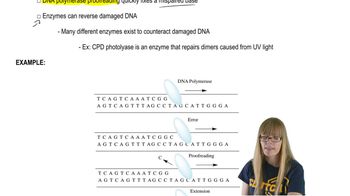
Proofreading is a 3' to 5' exonuclease function of DNA polymerase that removes incorrectly paired nucleotides immediately after they are added. This activity significantly reduces replication errors by correcting mismatches before DNA synthesis continues.
Recommended video:
Guided course
01:45
DNA Proofreading

Mismatch Repair System

The mismatch repair system detects and repairs base-pair mismatches that escape proofreading after DNA replication. It enhances genomic stability by correcting errors that would otherwise lead to mutations.
Recommended video:
Guided course
05:44
Repair Pathways