The gene controlling the Xg blood group alleles (Xg⁺ and Xg⁻) and the gene controlling a newly described form of inherited recessive muscle weakness called episodic muscle weakness (EMWX) (Ryan et al., 1999) are closely linked on the X chromosome in humans at position Xp22.3 (the tip of the short arm). A male with EMWX who is Xg⁻ marries a woman who is Xg⁺ and they have eight daughters and one son, all of whom are normal for muscle function, the male being Xg⁺ and all the daughters being heterozygous at both the EMWX and Xg loci. Following is a table that lists three of the daughters with the phenotypes of their husbands and children. Create a pedigree that represents all data stated above and in the following table.

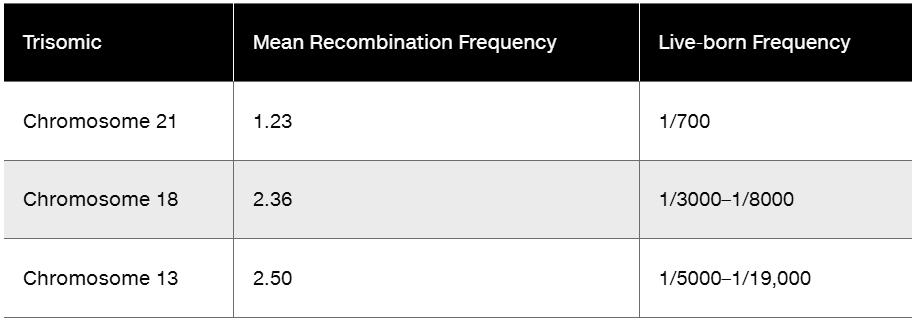
Because of the relatively high frequency of meiotic errors that lead to developmental abnormalities in humans, many research efforts have focused on identifying correlations between error frequency and chromosome morphology and behavior. Tease et al. (2002) studied human fetal oocytes of chromosomes 21, 18, and 13 using an immunocytological approach that allowed a direct estimate of the frequency and position of meiotic recombination. Below is a summary of information [modified from Tease et al. (2002)] that compares recombination frequency with the frequency of trisomy for chromosomes 21, 18, and 13. (Note: You may want to read appropriate portions of Chapter 8 for descriptions of these trisomic conditions.)

Other studies indicate that the number of crossovers per oocyte is somewhat constant, and it has been suggested that positive chromosomal interference acts to spread out a limited number of crossovers among as many chromosomes as possible. Considering information in part (a), speculate on the selective advantage positive chromosomal interference might confer.
Verified step by step guidance
Verified video answer for a similar problem:
Key Concepts
Meiotic Errors
Recombination Frequency
Positive Chromosomal Interference
The gene controlling the Xg blood group alleles (Xg⁺ and Xg⁻) and the gene controlling a newly described form of inherited recessive muscle weakness called episodic muscle weakness (EMWX) are closely linked on the X chromosome in humans at position Xp22.3 (the tip of the short arm). A male with EMWX who is Xg⁻ marries a woman who is Xg⁺ and they have eight daughters and one son, all of whom are normal for muscle function, the male being Xg⁺ and all the daughters being heterozygous at both the EMWX and Xg loci. Following is a table that lists three of the daughters with the phenotypes of their husbands and children.
For each of the offspring, indicate whether or not a crossover was required to produce the phenotypes that are given.
Because of the relatively high frequency of meiotic errors that lead to developmental abnormalities in humans, many research efforts have focused on identifying correlations between error frequency and chromosome morphology and behavior. Tease et al. (2002) studied human fetal oocytes of chromosomes 21, 18, and 13 using an immunocytological approach that allowed a direct estimate of the frequency and position of meiotic recombination. Below is a summary of information that compares recombination frequency with the frequency of trisomy for chromosomes 21, 18, and 13.
What conclusions can be drawn from these data in terms of recombination and nondisjunction frequencies? How might recombination frequencies influence trisomic frequencies?
