What safety considerations must be taken before CRISPR-Cas is used to edit human embryos to cure disease?
Table of contents
- 1. Introduction to Genetics51m
- 2. Mendel's Laws of Inheritance3h 37m
- 3. Extensions to Mendelian Inheritance2h 41m
- 4. Genetic Mapping and Linkage2h 28m
- 5. Genetics of Bacteria and Viruses1h 21m
- 6. Chromosomal Variation1h 48m
- 7. DNA and Chromosome Structure56m
- 8. DNA Replication1h 10m
- 9. Mitosis and Meiosis1h 34m
- 10. Transcription1h 0m
- 11. Translation58m
- 12. Gene Regulation in Prokaryotes1h 19m
- 13. Gene Regulation in Eukaryotes44m
- 14. Genetic Control of Development44m
- 15. Genomes and Genomics1h 50m
- 16. Transposable Elements47m
- 17. Mutation, Repair, and Recombination1h 6m
- 18. Molecular Genetic Tools19m
- 19. Cancer Genetics29m
- 20. Quantitative Genetics1h 26m
- 21. Population Genetics50m
- 22. Evolutionary Genetics29m
18. Molecular Genetic Tools
Genetic Cloning
Problem 1d
Textbook Question
How can gene knockouts, transgenic animals, and gene editing techniques be used to explore gene function?
Verified step by step guidance1
Understand that gene knockouts involve disabling or 'knocking out' a specific gene in an organism to observe the resulting changes in phenotype, which helps infer the gene's function.
Recognize that transgenic animals are created by introducing foreign genes into their genome, allowing researchers to study the effects of overexpressing or misexpressing a gene and thus gain insights into its role.
Learn that gene editing techniques, such as CRISPR-Cas9, enable precise modifications of DNA sequences, including gene knockouts, insertions, or corrections, providing a powerful tool to investigate gene function by observing the consequences of these targeted changes.
Compare the phenotypic outcomes from gene knockouts, transgenic models, and gene-edited organisms to identify how specific genes contribute to development, physiology, or disease processes.
Integrate data from these approaches to build a comprehensive understanding of gene function, considering both loss-of-function and gain-of-function effects.
Verified video answer for a similar problem:This video solution was recommended by our tutors as helpful for the problem above
Video duration:
1mPlay a video:
Was this helpful?
Key Concepts
Here are the essential concepts you must grasp in order to answer the question correctly.
Gene Knockouts
Gene knockouts involve disabling or deleting a specific gene in an organism to study the effects of its loss. This helps researchers understand the gene's role by observing changes in phenotype or biological processes when the gene is inactive.
Recommended video:
Guided course
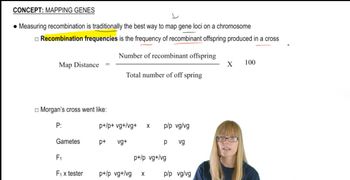
Mapping Genes
Transgenic Animals
Transgenic animals carry foreign or modified genes introduced into their genome. By expressing or overexpressing these genes, scientists can investigate gene function, regulation, and the impact of specific genetic changes in a living organism.
Recommended video:
Guided course
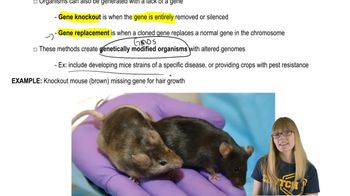
Transgenic Organisms and Gene Therapy
Gene Editing Techniques
Gene editing methods like CRISPR-Cas9 allow precise modification of DNA sequences within an organism's genome. These tools enable targeted gene disruption, correction, or insertion, facilitating detailed functional studies and modeling of genetic diseases.
Recommended video:
Guided course
Mapping Genes
Related Videos
Related Practice
Open Question
24
views