A chicken breeder has a population of chickens where the average number of eggs laid per hen per month is 34. The narrow-sense heritability is 0.75. With this information is it likely that a breeder could select for an increase in eggs per hen laid each month?
Table of contents
- 1. Introduction to Genetics51m
- 2. Mendel's Laws of Inheritance3h 37m
- 3. Extensions to Mendelian Inheritance2h 41m
- 4. Genetic Mapping and Linkage2h 28m
- 5. Genetics of Bacteria and Viruses1h 21m
- 6. Chromosomal Variation1h 48m
- 7. DNA and Chromosome Structure56m
- 8. DNA Replication1h 10m
- 9. Mitosis and Meiosis1h 34m
- 10. Transcription1h 0m
- 11. Translation58m
- 12. Gene Regulation in Prokaryotes1h 19m
- 13. Gene Regulation in Eukaryotes44m
- 14. Genetic Control of Development44m
- 15. Genomes and Genomics1h 50m
- 16. Transposable Elements47m
- 17. Mutation, Repair, and Recombination1h 6m
- 18. Molecular Genetic Tools19m
- 19. Cancer Genetics29m
- 20. Quantitative Genetics1h 26m
- 21. Population Genetics50m
- 22. Evolutionary Genetics29m
20. Quantitative Genetics
Heritability
Problem 3
Textbook Question
Define the following:
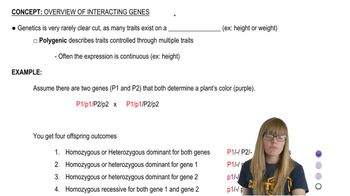
(a) Polygenic
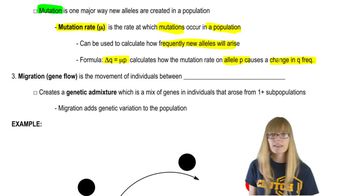
(b) Additive alleles
(c) Correlation
(d) Monozygotic and dizygotic twins
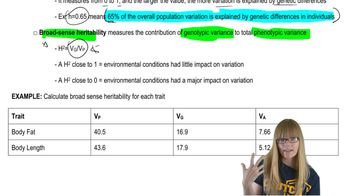
(e) Heritability
(f) QTL
(g) Continuous variation
Verified step by step guidance1
Define (a) Polygenic: Explain that polygenic traits are controlled by multiple genes, each contributing a small effect to the overall phenotype, resulting in continuous variation rather than discrete categories.
Define (b) Additive alleles: Describe additive alleles as alleles whose effects on a trait sum up in a cumulative way, meaning each allele adds a certain amount to the phenotype independently of other alleles.
Define (c) Correlation: Clarify that correlation in genetics refers to a statistical measure that describes the degree to which two traits or variables are related or vary together in a population.
Define (d) Monozygotic and dizygotic twins: Monozygotic twins originate from a single fertilized egg that splits, making them genetically identical, while dizygotic twins come from two separate eggs fertilized by two different sperm, making them genetically similar like regular siblings.
Define (e) Heritability: Explain heritability as the proportion of phenotypic variation in a population that is attributable to genetic variation among individuals, often expressed as a value between 0 and 1.
Define (f) QTL (Quantitative Trait Locus): Describe QTL as a specific region of the genome that is associated with variation in a quantitative trait, identified through statistical analysis linking genetic markers to phenotypic variation.
Define (g) Continuous variation: Explain continuous variation as a type of phenotypic variation where traits show a range of small differences across a population, often influenced by multiple genes and environmental factors, producing a smooth distribution of phenotypes.
Verified video answer for a similar problem:This video solution was recommended by our tutors as helpful for the problem above
Video duration:
2mPlay a video:
Was this helpful?
Key Concepts
Here are the essential concepts you must grasp in order to answer the question correctly.
Polygenic
Polygenic refers to a trait controlled by multiple genes, each contributing a small effect to the phenotype. Unlike single-gene traits, polygenic traits show continuous variation, such as height or skin color, because the combined influence of many genes produces a range of outcomes.
Recommended video:
Guided course
Interacting Genes Overview
Additive Alleles
Additive alleles are gene variants whose effects sum up to influence a trait. Each allele contributes a certain amount to the phenotype, and the total effect is the sum of all alleles involved, explaining gradual differences in traits like weight or intelligence.
Recommended video:
Guided course
New Alleles and Migration
Heritability
Heritability measures the proportion of phenotypic variation in a population that is due to genetic differences among individuals. It ranges from 0 to 1 and helps determine how much genetics versus environment influences a trait.
Recommended video:
Guided course
Calculating Heritability
Watch next
Master Calculating Heritability with a bite sized video explanation from Kylia
Start learningRelated Videos
Related Practice
Multiple Choice
508
views
2
rank