Describe the significance of the Genome 10K project.
Table of contents
- 1. Introduction to Genetics51m
- 2. Mendel's Laws of Inheritance3h 37m
- 3. Extensions to Mendelian Inheritance2h 41m
- 4. Genetic Mapping and Linkage2h 28m
- 5. Genetics of Bacteria and Viruses1h 21m
- 6. Chromosomal Variation1h 48m
- 7. DNA and Chromosome Structure56m
- 8. DNA Replication1h 10m
- 9. Mitosis and Meiosis1h 34m
- 10. Transcription1h 0m
- 11. Translation58m
- 12. Gene Regulation in Prokaryotes1h 19m
- 13. Gene Regulation in Eukaryotes44m
- 14. Genetic Control of Development44m
- 15. Genomes and Genomics1h 50m
- 16. Transposable Elements47m
- 17. Mutation, Repair, and Recombination1h 6m
- 18. Molecular Genetic Tools19m
- 19. Cancer Genetics29m
- 20. Quantitative Genetics1h 26m
- 21. Population Genetics50m
- 22. Evolutionary Genetics29m
15. Genomes and Genomics
Genomics and Human Medicine
Problem 23
Textbook Question
What is the difference between a knockout animal and a transgenic animal?
Verified step by step guidance1
Step 1: Understand the definition of a knockout animal. A knockout animal is one in which a specific gene has been intentionally disrupted or 'knocked out' to study the effects of losing that gene's function. This is usually done by targeted gene deletion or inactivation.
Step 2: Understand the definition of a transgenic animal. A transgenic animal is one that has had foreign DNA introduced into its genome, which can include additional copies of a gene, modified genes, or genes from other species, to study gene function or produce desired traits.
Step 3: Compare the genetic modifications. In knockout animals, the focus is on removing or disabling an existing gene, whereas in transgenic animals, new genetic material is added to the genome.
Step 4: Consider the purpose of each. Knockout animals help researchers understand the role of a gene by observing what happens when it is missing, while transgenic animals are used to study gene expression, protein function, or to create models with new traits.
Step 5: Summarize the key difference. The main distinction lies in the type of genetic alteration: knockout animals have genes removed or inactivated, and transgenic animals have new genes inserted.
Verified video answer for a similar problem:This video solution was recommended by our tutors as helpful for the problem above
Video duration:
31sPlay a video:
Was this helpful?
Key Concepts
Here are the essential concepts you must grasp in order to answer the question correctly.
Knockout Animal
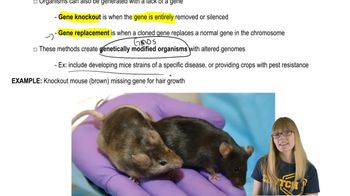
A knockout animal is genetically engineered to have one or more specific genes completely disabled or 'knocked out.' This is done to study the function of that gene by observing the effects of its absence on the organism's traits or development.
Recommended video:
Guided course
Gamete Development
Transgenic Animal
A transgenic animal contains foreign DNA that has been deliberately inserted into its genome. This added gene can come from the same or different species and is used to study gene function, produce proteins, or model diseases.
Recommended video:
Guided course
Transgenic Organisms and Gene Therapy
Genetic Engineering Techniques
Genetic engineering involves methods like gene targeting for knockouts and gene insertion for transgenics. Understanding these techniques helps differentiate how specific genes are removed or added to create knockout or transgenic animals.
Recommended video:
Guided course
The Genetic Code
Watch next
Master Human Genome Composition with a bite sized video explanation from Kylia
Start learningRelated Videos
Related Practice
Textbook Question
479
views