How do we know that mitotic chromosomes are derived from chromatin?
Verified step by step guidance
1
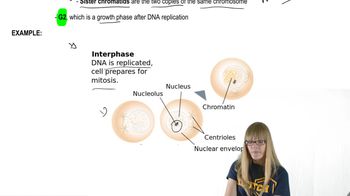
Understand the relationship between chromatin and chromosomes: Chromatin is the uncondensed form of genetic material found in the nucleus during interphase. It consists of DNA and associated proteins (histones). During mitosis, chromatin condenses into visible chromosomes, which are structures that facilitate the segregation of genetic material.
Examine the process of chromatin condensation: During prophase of mitosis, chromatin undergoes a series of structural changes, including supercoiling and folding, to form the compact, organized chromosomes. This condensation is observable under a microscope, providing direct evidence of the transformation.
Review experimental evidence: Scientists have used techniques such as staining and microscopy to observe chromatin in interphase and its transition into chromosomes during mitosis. Specific dyes, like Giemsa stain, bind to DNA and highlight the structural changes, confirming that chromosomes originate from chromatin.
Consider molecular studies: Biochemical analyses have shown that the DNA and histone composition of chromatin is identical to that of chromosomes. This supports the conclusion that chromosomes are condensed forms of chromatin.
Connect the functional significance: The condensation of chromatin into chromosomes ensures the accurate segregation of genetic material during cell division. This functional necessity further supports the idea that mitotic chromosomes are derived from chromatin.
Verified video answer for a similar problem:
This video solution was recommended by our tutors as helpful for the problem above
Video duration:
2m
Play a video:
Was this helpful?
Key Concepts
Here are the essential concepts you must grasp in order to answer the question correctly.
Chromatin Structure
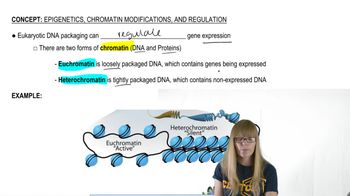
Chromatin is a complex of DNA and proteins found in the nucleus of eukaryotic cells. It exists in two forms: euchromatin, which is loosely packed and accessible for transcription, and heterochromatin, which is tightly packed and less accessible. During cell division, chromatin condenses to form visible chromosomes, making it essential to understand how this transition occurs to grasp the derivation of mitotic chromosomes.
Mitosis is the process of cell division that results in two genetically identical daughter cells, each with the same number of chromosomes as the parent cell. It involves several stages: prophase, metaphase, anaphase, and telophase, during which chromatin condenses into distinct chromosomes. Understanding mitosis is crucial for recognizing how chromatin transforms into chromosomes and how genetic material is accurately distributed.
The derivation of mitotic chromosomes from chromatin is supported by various experimental techniques, such as microscopy and biochemical assays. These methods have demonstrated that during mitosis, chromatin undergoes structural changes, leading to the formation of chromosomes. Observations of chromatin behavior during cell division provide critical insights into the relationship between chromatin and chromosomes.