Table of contents
- 1. Introduction to Genetics51m
- 2. Mendel's Laws of Inheritance3h 37m
- 3. Extensions to Mendelian Inheritance2h 41m
- 4. Genetic Mapping and Linkage2h 28m
- 5. Genetics of Bacteria and Viruses1h 21m
- 6. Chromosomal Variation1h 48m
- 7. DNA and Chromosome Structure56m
- 8. DNA Replication1h 10m
- 9. Mitosis and Meiosis1h 34m
- 10. Transcription1h 0m
- 11. Translation58m
- 12. Gene Regulation in Prokaryotes1h 19m
- 13. Gene Regulation in Eukaryotes44m
- 14. Genetic Control of Development44m
- 15. Genomes and Genomics1h 50m
- 16. Transposable Elements47m
- 17. Mutation, Repair, and Recombination1h 6m
- 18. Molecular Genetic Tools19m
- 19. Cancer Genetics29m
- 20. Quantitative Genetics1h 26m
- 21. Population Genetics50m
- 22. Evolutionary Genetics29m
18. Molecular Genetic Tools
Methods for Analyzing DNA
Problem 1e
Textbook Question
From GWAS, how do we know which genes are associated with a particular genetic disorder?
Verified step by step guidance1
Understand the concept of GWAS (Genome-Wide Association Studies): GWAS is a method used to identify genetic variants associated with specific traits or disorders by analyzing the genomes of large groups of individuals. It compares the frequency of genetic markers (such as SNPs) between affected and unaffected individuals.
Collect and prepare data: Gather genomic data from a large population, including individuals with the genetic disorder (cases) and those without it (controls). Ensure the sample size is large enough to provide statistical power for detecting associations.
Perform statistical analysis: Use statistical methods to test for associations between genetic markers (e.g., SNPs) and the disorder. This involves calculating p-values to determine whether the frequency of a particular marker is significantly different between cases and controls.
Interpret significant associations: Identify genetic markers that show strong statistical associations with the disorder. These markers are often located near or within genes that may play a role in the disorder. Use linkage disequilibrium analysis to pinpoint the specific gene or region of interest.
Validate and investigate candidate genes: Conduct further experiments, such as functional studies, to confirm the role of the identified genes in the disorder. This may involve studying gene expression, protein function, or creating model organisms to understand the biological mechanisms involved.
Verified video answer for a similar problem:This video solution was recommended by our tutors as helpful for the problem above
Video duration:
1mPlay a video:
Was this helpful?
Key Concepts
Here are the essential concepts you must grasp in order to answer the question correctly.
Genome-Wide Association Studies (GWAS)
GWAS are research methods used to identify genetic variants associated with specific diseases by scanning the genomes of many individuals. They compare the DNA of individuals with a particular disorder to those without, looking for common genetic markers. This approach helps pinpoint genes that may contribute to the risk of developing certain conditions.
Recommended video:
Guided course
Genetics of Development
Single Nucleotide Polymorphisms (SNPs)
SNPs are the most common type of genetic variation among people, where a single nucleotide in the genome differs between individuals. In GWAS, researchers often focus on SNPs to find associations with diseases, as these variations can influence gene function and contribute to the development of genetic disorders.
Recommended video:
Guided course
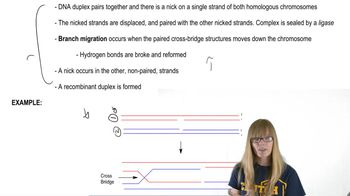
Recombination after Single Strand Breaks
Statistical Significance in Genetic Studies
Statistical significance is crucial in GWAS to determine whether the observed associations between genetic variants and diseases are likely due to chance. Researchers use p-values and other statistical measures to assess the strength of these associations, ensuring that the findings are reliable and can be replicated in independent studies.
Recommended video:
Guided course
Genetics of Development
Watch next
Master Methods for Analyzing DNA and RNA with a bite sized video explanation from Kylia
Start learningRelated Videos
Related Practice
Multiple Choice
In gel electrophoresis as a method for analyzing DNA, why is a DNA ladder (molecular weight marker) useful and why is it included on the gel?