Write a short essay that discusses how crossing over can be detected and how the resultant data provide the basis of chromosome mapping.
Table of contents
- 1. Introduction to Genetics51m
- 2. Mendel's Laws of Inheritance3h 37m
- 3. Extensions to Mendelian Inheritance2h 41m
- 4. Genetic Mapping and Linkage2h 28m
- 5. Genetics of Bacteria and Viruses1h 21m
- 6. Chromosomal Variation1h 48m
- 7. DNA and Chromosome Structure56m
- 8. DNA Replication1h 10m
- 9. Mitosis and Meiosis1h 34m
- 10. Transcription1h 0m
- 11. Translation58m
- 12. Gene Regulation in Prokaryotes1h 19m
- 13. Gene Regulation in Eukaryotes44m
- 14. Genetic Control of Development44m
- 15. Genomes and Genomics1h 50m
- 16. Transposable Elements47m
- 17. Mutation, Repair, and Recombination1h 6m
- 18. Molecular Genetic Tools19m
- 19. Cancer Genetics29m
- 20. Quantitative Genetics1h 26m
- 21. Population Genetics50m
- 22. Evolutionary Genetics29m
4. Genetic Mapping and Linkage
Mapping Overview
Problem 31a
Textbook Question
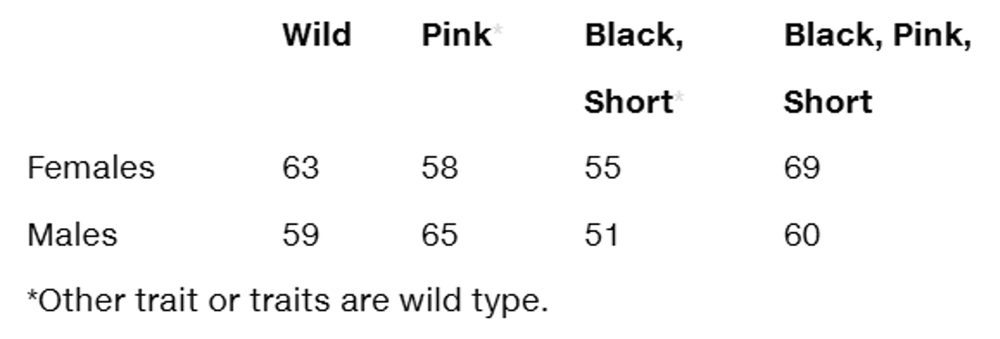
Drosophila melanogaster has one pair of sex chromosomes (XX or XY) and three pairs of autosomes, referred to as chromosomes II, III, and IV. A genetics student discovered a male fly with very short (sh) legs. Using this male, the student was able to establish a pure breeding stock of this mutant and found that it was recessive. She then incorporated the mutant into a stock containing the recessive gene black (b, body color located on chromosome II) and the recessive gene pink (p, eye color located on chromosome III). A female from the homozygous black, pink, short stock was then mated to a wild-type male. The F1 males of this cross were all wild type and were then backcrossed to the homozygous b, p, sh females. The F2 results appeared as shown in the following table. No other phenotypes were observed.

Based on these results, the student was able to assign short to a linkage group (a chromosome). Which one was it? Include your step-by-step reasoning.
Verified step by step guidance1
Step 1: Understand the genetic background and the traits involved. The traits are black body color (b) on chromosome II, pink eye color (p) on chromosome III, and short legs (sh) of unknown chromosomal location. The mutant alleles are recessive, and the female used in the backcross is homozygous recessive for all three traits (b, p, sh). The male parent in the backcross is wild type for all traits.
Step 2: Analyze the F2 phenotypic classes and their counts. The phenotypes are Wild type, Pink only, Black and Short together, and Black, Pink, and Short together. Since the female parent is homozygous recessive for all three traits, the phenotypes in the progeny reflect the alleles contributed by the male parent and the recombination events between the genes.
Step 3: Determine linkage by comparing expected independent assortment ratios to observed data. If short legs (sh) were on a different chromosome from black (b) or pink (p), the phenotypes involving sh would assort independently, and the phenotypic ratios would reflect independent assortment. However, if sh is linked to either b or p, the phenotypes involving those traits will show non-independent assortment, with certain combinations appearing more frequently.
Step 4: Compare the phenotypic counts of 'Black, Short' and 'Black, Pink, Short' classes. If short legs (sh) is linked to black (b) on chromosome II, these two classes should be more frequent and appear together more often than expected by chance. Conversely, if sh is linked to pink (p) on chromosome III, the 'Pink' and 'Black, Pink, Short' classes would show linkage patterns.
Step 5: Conclude the linkage group of short legs (sh) by identifying which chromosome's recessive trait co-segregates with sh. The chromosome whose recessive trait appears together with sh more frequently than expected indicates linkage. Therefore, based on the phenotypic distribution, assign short legs (sh) to the chromosome that shows this pattern of linkage.
Verified video answer for a similar problem:This video solution was recommended by our tutors as helpful for the problem above
Video duration:
1mPlay a video:
Was this helpful?
Key Concepts
Here are the essential concepts you must grasp in order to answer the question correctly.
Linkage and Chromosome Mapping
Linkage refers to genes located close together on the same chromosome that tend to be inherited together. By analyzing offspring phenotypes and their frequencies, geneticists can determine whether genes are linked and assign them to specific chromosomes. This concept is essential for interpreting the inheritance patterns in the F2 generation and identifying the chromosome carrying the short (sh) gene.
Recommended video:
Guided course
Chi Square and Linkage
Recessive Traits and Pure Breeding
A recessive trait only appears phenotypically when an organism has two copies of the recessive allele (homozygous recessive). Pure breeding stocks are homozygous for the trait, ensuring consistent expression in offspring. Understanding this helps explain the initial crosses and the phenotypic ratios observed in the progeny.
Recommended video:
Guided course
Traits and Variance
Sex Chromosomes vs. Autosomes in Drosophila
Drosophila melanogaster has one pair of sex chromosomes (XX or XY) and three pairs of autosomes (II, III, IV). Knowing the chromosomal location of genes (e.g., black on chromosome II, pink on III) allows geneticists to deduce linkage groups by comparing expected and observed phenotypic ratios, especially when incorporating a new gene like short.
Recommended video:
Guided course
Human Sex Chromosomes
Related Videos
Related Practice
Textbook Question
616
views
