You have identified five genes in S. cerevisiae that are induced when the yeast are grown in a high-salt (NaCl) medium. To study the potential roles of these genes in acclimation to growth in high-salt conditions, you wish to examine the phenotypes of loss- and gain-of-function alleles of each. How will you do this?
Table of contents
- 1. Introduction to Genetics51m
- 2. Mendel's Laws of Inheritance3h 37m
- 3. Extensions to Mendelian Inheritance2h 41m
- 4. Genetic Mapping and Linkage2h 28m
- 5. Genetics of Bacteria and Viruses1h 21m
- 6. Chromosomal Variation1h 48m
- 7. DNA and Chromosome Structure56m
- 8. DNA Replication1h 10m
- 9. Mitosis and Meiosis1h 34m
- 10. Transcription1h 0m
- 11. Translation58m
- 12. Gene Regulation in Prokaryotes1h 19m
- 13. Gene Regulation in Eukaryotes44m
- 14. Genetic Control of Development44m
- 15. Genomes and Genomics1h 50m
- 16. Transposable Elements47m
- 17. Mutation, Repair, and Recombination1h 6m
- 18. Molecular Genetic Tools19m
- 19. Cancer Genetics29m
- 20. Quantitative Genetics1h 26m
- 21. Population Genetics50m
- 22. Evolutionary Genetics29m
17. Mutation, Repair, and Recombination
DNA Repair
Problem 23b
Textbook Question
Many of the gene products involved in DNA synthesis were initially defined by studying mutant E. coli strains that could not synthesize DNA.
The dnaQ gene encodes the ε subunit of DNA polymerase. What effect is expected from a mutation in this gene?
Verified step by step guidance1
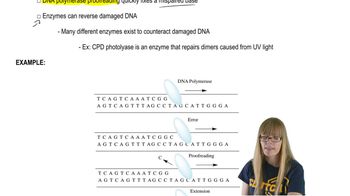
Understand the role of the dnaQ gene: It encodes the ε (epsilon) subunit of DNA polymerase III in E. coli, which is responsible for the proofreading activity during DNA replication.
Recall that the ε subunit has 3' to 5' exonuclease activity, which means it can remove incorrectly incorporated nucleotides, ensuring high fidelity of DNA synthesis.
Predict the effect of a mutation in the dnaQ gene: If the ε subunit is defective or missing, the proofreading function will be impaired, leading to an increase in replication errors.
Consider the biological consequence: Without proper proofreading, the mutation rate during DNA replication will increase, potentially causing accumulation of mutations in the bacterial genome.
Summarize that a mutation in dnaQ is expected to reduce the accuracy of DNA synthesis by compromising the proofreading ability of DNA polymerase III.
Verified video answer for a similar problem:This video solution was recommended by our tutors as helpful for the problem above
Video duration:
1mPlay a video:
Was this helpful?
Key Concepts
Here are the essential concepts you must grasp in order to answer the question correctly.
Role of DNA Polymerase in DNA Synthesis
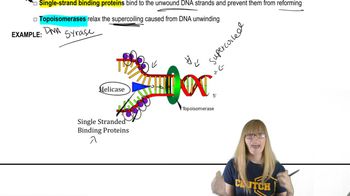
DNA polymerase is the enzyme responsible for synthesizing new DNA strands by adding nucleotides complementary to the template strand. It ensures accurate replication of the genome during cell division, with multiple subunits contributing to its function.
Recommended video:
Guided course
DNA Proofreading
Function of the ε Subunit (dnaQ Gene Product)
The ε subunit of DNA polymerase, encoded by the dnaQ gene, provides 3' to 5' exonuclease proofreading activity. This function corrects errors by removing incorrectly incorporated nucleotides, thereby increasing the fidelity of DNA replication.
Recommended video:
Guided course
Functional Genomics
Effects of Mutations in dnaQ on DNA Replication
Mutations in the dnaQ gene impair the proofreading ability of DNA polymerase, leading to increased replication errors and higher mutation rates. Such defects can cause genomic instability and affect cell viability or function.
Recommended video:
Guided course
Steps to DNA Replication
Related Videos
Related Practice
Textbook Question
467
views
