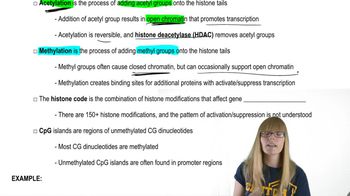
What parts of the genome are reversibly methylated? How does this affect gene expression?
Table of contents
- 1. Introduction to Genetics51m
- 2. Mendel's Laws of Inheritance3h 37m
- 3. Extensions to Mendelian Inheritance2h 41m
- 4. Genetic Mapping and Linkage2h 28m
- 5. Genetics of Bacteria and Viruses1h 21m
- 6. Chromosomal Variation1h 48m
- 7. DNA and Chromosome Structure56m
- 8. DNA Replication1h 10m
- 9. Mitosis and Meiosis1h 34m
- 10. Transcription1h 0m
- 11. Translation58m
- 12. Gene Regulation in Prokaryotes1h 19m
- 13. Gene Regulation in Eukaryotes44m
- 14. Genetic Control of Development44m
- 15. Genomes and Genomics1h 50m
- 16. Transposable Elements47m
- 17. Mutation, Repair, and Recombination1h 6m
- 18. Molecular Genetic Tools19m
- 19. Cancer Genetics29m
- 20. Quantitative Genetics1h 26m
- 21. Population Genetics50m
- 22. Evolutionary Genetics29m
13. Gene Regulation in Eukaryotes
Epigenetics, Chromatin Modifications, and Regulation
Problem 7
Textbook Question
Provide a brief description of two different types of histone modification and how they impact transcription.
Verified step by step guidance1
Step 1: Understand that histone modifications are chemical changes to the histone proteins around which DNA is wrapped, affecting how tightly or loosely DNA is packaged and thus influencing gene expression.
Step 2: Describe acetylation, a type of histone modification where an acetyl group is added to lysine residues on histone tails. This reduces the positive charge on histones, decreasing their affinity for negatively charged DNA, leading to a more relaxed chromatin structure and generally promoting transcription.
Step 3: Describe methylation, another histone modification where methyl groups are added to lysine or arginine residues on histones. Depending on the specific site and degree of methylation, this can either activate or repress transcription by altering chromatin structure or recruiting regulatory proteins.
Step 4: Explain that acetylation is typically associated with transcriptional activation because it opens up chromatin, making DNA more accessible to transcription factors and RNA polymerase.
Step 5: Explain that methylation can have dual effects: for example, trimethylation of histone H3 at lysine 4 (H3K4me3) is linked to active transcription, while trimethylation at lysine 9 (H3K9me3) is associated with transcriptional repression and heterochromatin formation.
Verified video answer for a similar problem:This video solution was recommended by our tutors as helpful for the problem above
Video duration:
28sPlay a video:
Was this helpful?
Key Concepts
Here are the essential concepts you must grasp in order to answer the question correctly.
Histone Modification
Histone modifications are chemical changes to the histone proteins around which DNA is wrapped. These modifications, such as methylation or acetylation, alter chromatin structure and influence gene accessibility, thereby regulating transcriptional activity.
Recommended video:
Guided course
Histone Protein Modifications
Histone Acetylation
Histone acetylation involves adding acetyl groups to lysine residues on histone tails, which neutralizes positive charges and reduces histone-DNA interaction. This leads to a more relaxed chromatin structure, promoting transcription by allowing transcription factors easier access to DNA.
Recommended video:
Guided course
Histone Protein Modifications
Histone Methylation
Histone methylation adds methyl groups to specific lysine or arginine residues on histones. Depending on the site and degree of methylation, it can either activate or repress transcription by recruiting proteins that modify chromatin structure or interact with the transcription machinery.
Recommended video:
Guided course
Histone Protein Modifications
Related Videos
Related Practice
Textbook Question
565
views