Pearson+ LogoPearson+ Logo
Ch. 17 - Transcriptional Regulation in Eukaryotes
Klug - Concepts of Genetics  12th Edition
Klug12th EditionConcepts of Genetics ISBN: 9780135564776Not the one you use?Change textbook
Chapter 17, Problem 6

A number of experiments have demonstrated that areas of the genome that are transcriptionally inactive are also resistant to DNase I digestion. However, transcriptionally active areas are DNase I sensitive. Describe how DNase I resistance or sensitivity might indicate transcriptional activity.

Verified step by step guidance
1
Understand that DNase I is an enzyme that cuts DNA, but it can only access DNA that is not tightly packed or protected by proteins.
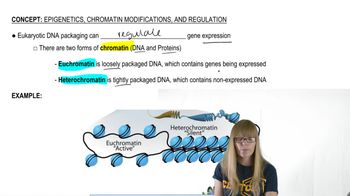
Recognize that transcriptionally active regions of the genome are usually in an open chromatin state, meaning the DNA is loosely packed and accessible to enzymes like DNase I.
Know that transcriptionally inactive regions are often tightly packed into heterochromatin, making the DNA less accessible and therefore resistant to DNase I digestion.
Interpret DNase I sensitivity as an indicator that the chromatin is open and the DNA is accessible, which correlates with active transcription because the transcription machinery can access the DNA.
Conclude that DNase I resistance suggests the chromatin is closed or condensed, preventing transcription factors and RNA polymerase from accessing the DNA, thus indicating transcriptional inactivity.

Verified video answer for a similar problem:

This video solution was recommended by our tutors as helpful for the problem above.
Video duration:
3m
Was this helpful?

Key Concepts

Here are the essential concepts you must grasp in order to answer the question correctly.

Chromatin Structure and Accessibility

Chromatin exists in two main forms: euchromatin (loosely packed) and heterochromatin (tightly packed). Transcriptionally active regions are usually euchromatic, making DNA more accessible to enzymes like DNase I. In contrast, inactive regions are heterochromatic and less accessible, leading to DNase I resistance.
Recommended video:

DNase I Hypersensitivity Assay

DNase I is an enzyme that cleaves DNA where it is exposed and not tightly bound by proteins. Regions sensitive to DNase I digestion indicate open chromatin and active transcription, while resistant regions suggest closed chromatin and transcriptional inactivity. This assay helps map regulatory elements.
Recommended video:
Guided course
03:44
Plaques and Experiments

Transcriptional Regulation and DNA-Protein Interactions

Transcription factors and other regulatory proteins bind to DNA in active regions, altering chromatin structure to facilitate transcription. These interactions open the chromatin, increasing DNase I sensitivity. Conversely, inactive regions lack such interactions, maintaining a compact structure resistant to DNase I.
Recommended video: