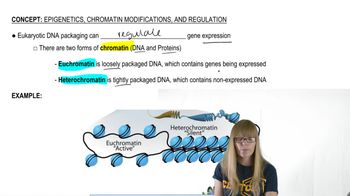
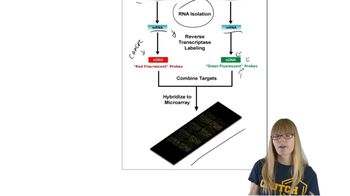
A number of experiments have demonstrated that areas of the genome that are transcriptionally inactive are also resistant to DNase I digestion. However, transcriptionally active areas are DNase I sensitive. Describe how DNase I resistance or sensitivity might indicate transcriptional activity.
Ch. 17 - Transcriptional Regulation in Eukaryotes

Chapter 17, Problem 9
Chromatin remodeling by the SWI/SNF complex requires hydrolysis of ATP. What purpose does this serve?
Verified step by step guidance1
Understand that chromatin remodeling involves changing the structure of chromatin to regulate access to DNA for processes like transcription.
Recognize that the SWI/SNF complex is a type of chromatin remodeler that uses energy to reposition or evict nucleosomes on DNA.
Identify that ATP hydrolysis provides the energy required for the SWI/SNF complex to physically alter nucleosome positioning.
Explain that the hydrolysis of ATP to ADP + Pi releases energy, which the SWI/SNF complex harnesses to disrupt histone-DNA interactions.
Conclude that this energy-dependent remodeling facilitates access of transcription factors and other proteins to DNA, enabling gene expression regulation.

Verified video answer for a similar problem:
This video solution was recommended by our tutors as helpful for the problem above.
Video duration:
2mWas this helpful?
Key Concepts
Here are the essential concepts you must grasp in order to answer the question correctly.
Chromatin Structure and Accessibility
Chromatin is composed of DNA wrapped around histone proteins, forming nucleosomes that compact the DNA and regulate gene accessibility. Remodeling chromatin alters this structure to expose or hide DNA regions, thereby controlling gene expression.
Recommended video:
Guided course
Chromatin
SWI/SNF Complex Function
The SWI/SNF complex is an ATP-dependent chromatin remodeling complex that repositions or ejects nucleosomes to change chromatin structure. This remodeling facilitates access of transcription factors and other proteins to DNA, influencing gene regulation.
Recommended video:
Guided course
Functional Genomics
Role of ATP Hydrolysis in Chromatin Remodeling
ATP hydrolysis provides the energy required for the SWI/SNF complex to disrupt histone-DNA interactions and reposition nucleosomes. This energy-dependent process enables dynamic changes in chromatin structure essential for regulating DNA accessibility.
Recommended video:
Guided course
Chromatin
Related Practice
Textbook Question
690
views
Textbook Question
Provide a brief description of two different types of histone modification and how they impact transcription.
707
views
Textbook Question
Present an overview of the manner in which chromatin can be remodeled. Describe the manner in which these remodeling processes influence transcription.
530
views
Textbook Question
Explain how the addition of acetyl groups to histones leads to a weaker association of DNA in nucleosomes.
456
views
Textbook Question
Distinguish between the cis-acting regulatory elements referred to as promoters and enhancers.
650
views
Textbook Question
Enhancers can influence the transcription of genes far away on the same chromosome. How are the effects of enhancers restricted so that they do not exert inappropriate transcriptional activation of non-target genes?
756
views