Pearson+ LogoPearson+ Logo
Ch. 17 - Transcriptional Regulation in Eukaryotes
Klug - Concepts of Genetics  12th Edition
Klug12th EditionConcepts of Genetics ISBN: 9780135564776Not the one you use?Change textbook
Chapter 17, Problem 10

Explain how the addition of acetyl groups to histones leads to a weaker association of DNA in nucleosomes.

Verified step by step guidance
1
Histones are proteins around which DNA is wrapped to form nucleosomes, the basic units of chromatin structure.
Histones have positively charged lysine residues that interact with the negatively charged phosphate groups of DNA, leading to a tight association.
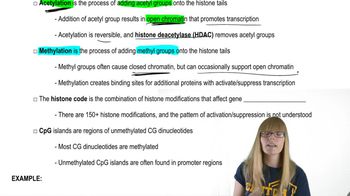
Acetylation involves the addition of acetyl groups (CH3CO) to the lysine residues on histone tails.
The addition of acetyl groups neutralizes the positive charge on lysine residues, reducing the electrostatic attraction between histones and DNA.
This reduction in attraction results in a looser association of DNA with histones, making the DNA more accessible for transcription and other processes.

Verified video answer for a similar problem:

This video solution was recommended by our tutors as helpful for the problem above.
Video duration:
4m
Was this helpful?

Key Concepts

Here are the essential concepts you must grasp in order to answer the question correctly.

Histone Acetylation

Histone acetylation is a post-translational modification where acetyl groups are added to the lysine residues of histone proteins. This modification neutralizes the positive charge of lysines, reducing the affinity between histones and the negatively charged DNA. As a result, the chromatin structure becomes more relaxed, facilitating access to the DNA for transcription and other processes.
Recommended video:
Guided course
07:55
Histone Protein Modifications

Nucleosome Structure

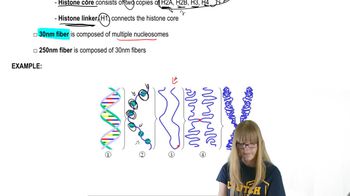
Nucleosomes are the fundamental units of chromatin, consisting of DNA wrapped around a core of histone proteins. Each nucleosome contains approximately 147 base pairs of DNA and is connected by linker DNA. The structural arrangement of nucleosomes plays a crucial role in the compaction of DNA and the regulation of gene expression, as tighter packing can inhibit access to the DNA.
Recommended video:
Guided course
07:10
Chromosome Structure

Chromatin Remodeling

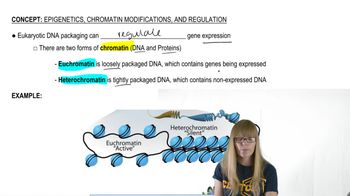
Chromatin remodeling refers to the dynamic changes in the structure of chromatin that allow for the regulation of gene expression. This process involves the repositioning or restructuring of nucleosomes, often facilitated by ATP-dependent chromatin remodeling complexes. Acetylation of histones is one mechanism that promotes chromatin remodeling, leading to a more open and accessible chromatin state, which is essential for transcriptional activation.
Recommended video: