Francis Crick proposed the 'adaptor hypothesis' for the function of tRNA. Why did he choose that description?
Verified step by step guidance
1
Understand the context: Francis Crick proposed the 'adaptor hypothesis' to explain how the genetic code in mRNA is translated into proteins, specifically how amino acids are matched to the correct codons during protein synthesis.
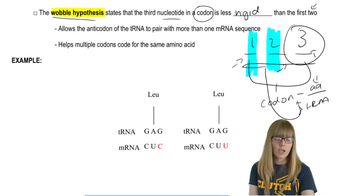
Recall the role of tRNA: Transfer RNA (tRNA) molecules serve as adaptors that physically link the nucleotide sequence of mRNA to the amino acid sequence of proteins by carrying specific amino acids and recognizing codons through their anticodon loops.
Analyze the term 'adaptor': Crick used the term 'adaptor' because tRNA acts as a molecular bridge or adapter that connects two different types of biological information — nucleic acid sequences and amino acid sequences.
Consider the mechanism: Each tRNA has an anticodon that pairs with a complementary codon on the mRNA, and an attached amino acid that corresponds to that codon, effectively adapting the language of nucleotides to the language of proteins.
Summarize why the description fits: The 'adaptor hypothesis' highlights the unique function of tRNA as an intermediary that enables the translation of genetic information into functional proteins, which was a novel concept at the time.
Verified video answer for a similar problem:
This video solution was recommended by our tutors as helpful for the problem above
Video duration:
1m
Play a video:
Was this helpful?
Key Concepts
Here are the essential concepts you must grasp in order to answer the question correctly.
Adaptor Hypothesis
The adaptor hypothesis, proposed by Francis Crick, suggests that tRNA acts as an adaptor molecule that translates the nucleotide sequence of mRNA into the amino acid sequence of proteins. It physically links specific amino acids to their corresponding codons on the mRNA during protein synthesis.
tRNA molecules have a unique cloverleaf structure with an anticodon region that pairs with mRNA codons and an acceptor stem that attaches to a specific amino acid. This dual functionality enables tRNA to serve as a molecular bridge between nucleic acids and proteins.
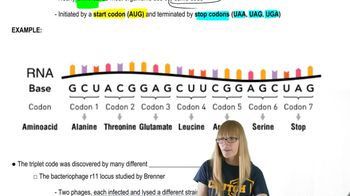
The genetic code is read in triplets called codons on mRNA, each specifying an amino acid. The adaptor hypothesis explains how the sequence of nucleotides is translated into a sequence of amino acids, with tRNA ensuring the correct amino acid is added according to the codon sequence.