Ligase catalyzes a reaction between the 5′ phosphate and the 3′ hydroxyl groups at the ends of DNA molecules. The enzyme calf intestinal phosphatase catalyzes the removal of the 5′5′ phosphate from DNA molecules. What would be the consequence of treating a cloning vector, before ligation, with calf intestinal phosphatase?
Table of contents
- 1. Introduction to Genetics51m
- 2. Mendel's Laws of Inheritance3h 37m
- 3. Extensions to Mendelian Inheritance2h 41m
- 4. Genetic Mapping and Linkage2h 28m
- 5. Genetics of Bacteria and Viruses1h 21m
- 6. Chromosomal Variation1h 48m
- 7. DNA and Chromosome Structure56m
- 8. DNA Replication1h 10m
- 9. Mitosis and Meiosis1h 34m
- 10. Transcription1h 0m
- 11. Translation58m
- 12. Gene Regulation in Prokaryotes1h 19m
- 13. Gene Regulation in Eukaryotes44m
- 14. Genetic Control of Development44m
- 15. Genomes and Genomics1h 50m
- 16. Transposable Elements47m
- 17. Mutation, Repair, and Recombination1h 6m
- 18. Molecular Genetic Tools19m
- 19. Cancer Genetics29m
- 20. Quantitative Genetics1h 26m
- 21. Population Genetics50m
- 22. Evolutionary Genetics29m
18. Molecular Genetic Tools
Genetic Cloning
Problem 5
Textbook Question
Although many cloning applications involve introducing recombinant DNA into bacterial host cells, many other cell types are also used as hosts for recombinant DNA. Why?
Verified step by step guidance1
Understand that different host cells offer unique advantages for cloning recombinant DNA, depending on the goals of the experiment or application.
Recognize that bacterial cells, such as Escherichia coli, are commonly used because they grow quickly and are easy to manipulate genetically, but they may not perform certain post-translational modifications needed for some proteins.
Consider that eukaryotic host cells (like yeast, insect, or mammalian cells) are used when the recombinant protein requires proper folding, glycosylation, or other modifications that bacteria cannot provide.
Acknowledge that some host cells are chosen based on their ability to express large or complex genes, or to produce proteins in a form that is biologically active and functional in higher organisms.
Summarize that the choice of host cell depends on factors such as the type of recombinant DNA, the desired protein product, and the biological processes needed for correct expression and modification.
Verified video answer for a similar problem:This video solution was recommended by our tutors as helpful for the problem above
Video duration:
2mPlay a video:
Was this helpful?
Key Concepts
Here are the essential concepts you must grasp in order to answer the question correctly.
Host Cell Diversity in Recombinant DNA Technology
Different host cells, such as bacteria, yeast, and mammalian cells, are used in recombinant DNA technology because each offers unique advantages. For example, bacterial cells grow quickly and are easy to manipulate, while eukaryotic cells can perform complex post-translational modifications necessary for some proteins.
Recommended video:
Guided course
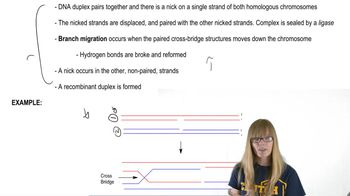
Recombination after Single Strand Breaks
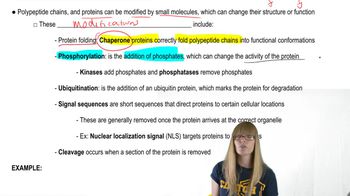
Post-Translational Modifications
Post-translational modifications are chemical changes to proteins after synthesis, such as glycosylation or phosphorylation. These modifications often occur only in eukaryotic cells, making certain host types essential for producing functional proteins that require these modifications.
Recommended video:
Guided course
Post Translational Modifications
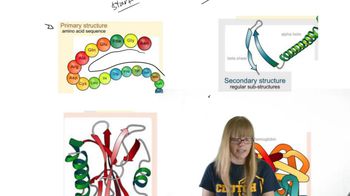
Expression Systems and Protein Folding
Different host cells provide distinct cellular environments that affect protein folding and expression levels. Proper folding is crucial for protein function, and some proteins require eukaryotic chaperones or cellular machinery absent in bacterial hosts, necessitating alternative host cells.
Recommended video:
Guided course
Proteins
Related Videos
Related Practice
Textbook Question
411
views