Pearson+ LogoPearson+ Logo
Ch. 18 - Post-transcriptional Regulation in Eukaryotes
Klug - Concepts of Genetics  12th Edition
Klug12th EditionConcepts of Genetics ISBN: 9780135564776Not the one you use?Change textbook
Chapter 18, Problem 20

How is it possible that a given mRNA in a cell is found throughout the cytoplasm but the protein that it encodes is only found in a few specific regions?

Verified step by step guidance
1
Understand that mRNA molecules can diffuse or be transported throughout the cytoplasm after they are transcribed in the nucleus, allowing them to be widely distributed within the cell.
Recognize that protein localization is often controlled post-translationally, meaning that even if the mRNA is everywhere, the protein may only be synthesized or stabilized in specific regions.
Consider mechanisms such as localized translation, where ribosomes translate the mRNA only in certain parts of the cytoplasm, often guided by signals in the mRNA sequence or by cellular structures.
Explore the role of protein targeting signals and cellular transport systems that direct the newly synthesized protein to specific locations, or degrade it elsewhere, resulting in spatially restricted protein presence.
Summarize that the discrepancy between mRNA distribution and protein localization arises from cellular processes controlling where and when the protein is made, modified, or maintained, despite the mRNA being widespread.

Verified video answer for a similar problem:

This video solution was recommended by our tutors as helpful for the problem above.
Video duration:
2m
Was this helpful?

Key Concepts

Here are the essential concepts you must grasp in order to answer the question correctly.

mRNA Localization and Transport

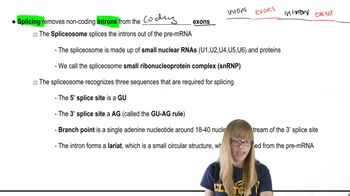
mRNA molecules can be distributed broadly within the cytoplasm, but their localization signals and transport mechanisms often direct them to specific cellular regions. This spatial regulation ensures that proteins are synthesized near their site of function, even if the mRNA is present elsewhere.
Recommended video:
Guided course
08:39
mRNA Processing

Localized Translation

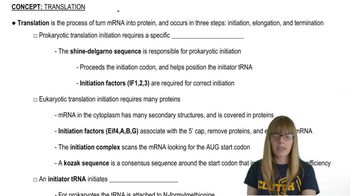
Translation of mRNA into protein can be spatially regulated, occurring only in certain parts of the cell. This means that although mRNA is widespread, the protein is produced only where translation machinery is activated or where specific factors promote protein synthesis.
Recommended video:
Guided course
07:58
Translation initiation

Protein Targeting and Anchoring

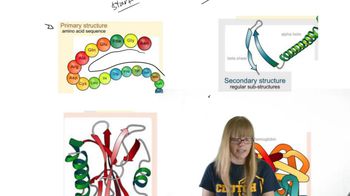
After synthesis, proteins can be transported or anchored to specific cellular compartments or structures. This selective localization restricts the protein’s presence to particular regions, explaining why the protein is found only in certain areas despite widespread mRNA distribution.
Recommended video: