If a cell suffers damage to its DNA while in S phase, how can this damage be repaired before the cell enters mitosis?
Table of contents
- 1. Introduction to Genetics51m
- 2. Mendel's Laws of Inheritance3h 37m
- 3. Extensions to Mendelian Inheritance2h 41m
- 4. Genetic Mapping and Linkage2h 28m
- 5. Genetics of Bacteria and Viruses1h 21m
- 6. Chromosomal Variation1h 48m
- 7. DNA and Chromosome Structure56m
- 8. DNA Replication1h 10m
- 9. Mitosis and Meiosis1h 34m
- 10. Transcription1h 0m
- 11. Translation58m
- 12. Gene Regulation in Prokaryotes1h 19m
- 13. Gene Regulation in Eukaryotes44m
- 14. Genetic Control of Development44m
- 15. Genomes and Genomics1h 50m
- 16. Transposable Elements47m
- 17. Mutation, Repair, and Recombination1h 6m
- 18. Molecular Genetic Tools19m
- 19. Cancer Genetics29m
- 20. Quantitative Genetics1h 26m
- 21. Population Genetics50m
- 22. Evolutionary Genetics29m
19. Cancer Genetics
Overview of Cancer
Problem 18
Textbook Question
How do normal cells protect themselves from accumulating mutations in genes that could lead to cancer? How do cancer cells differ from normal cells in these processes?
Verified step by step guidance1
Understand that normal cells have multiple mechanisms to protect their genome integrity and prevent the accumulation of mutations. These include DNA repair systems, cell cycle checkpoints, and programmed cell death (apoptosis).
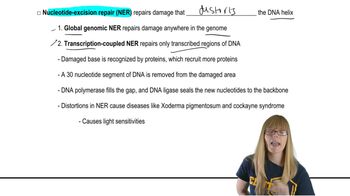
Recognize that DNA repair mechanisms detect and correct errors that occur during DNA replication or due to environmental damage. Examples include mismatch repair, nucleotide excision repair, and double-strand break repair.
Learn that cell cycle checkpoints act as surveillance points where the cell assesses DNA integrity before proceeding with division. If damage is detected, the cell can pause the cycle to allow repair or trigger apoptosis if the damage is irreparable.
Know that apoptosis is a controlled process by which cells with severe DNA damage self-destruct, preventing the propagation of mutations that could lead to cancer.
Contrast this with cancer cells, which often have defects in these protective mechanisms—such as mutations in tumor suppressor genes like TP53—leading to impaired DNA repair, faulty checkpoints, and resistance to apoptosis, allowing them to accumulate mutations and proliferate uncontrollably.
Verified video answer for a similar problem:This video solution was recommended by our tutors as helpful for the problem above
Video duration:
42sPlay a video:
Was this helpful?
Key Concepts
Here are the essential concepts you must grasp in order to answer the question correctly.
DNA Repair Mechanisms
Normal cells have multiple DNA repair systems that detect and fix mutations caused by environmental damage or replication errors. These mechanisms, such as nucleotide excision repair and mismatch repair, maintain genetic stability and prevent mutation accumulation that could lead to cancer.
Recommended video:
Guided course
Repair Pathways
Cell Cycle Checkpoints
Cell cycle checkpoints are control points where cells assess DNA integrity before progressing through division. In normal cells, these checkpoints halt the cycle to allow repair or trigger apoptosis if damage is irreparable, preventing propagation of mutations.
Recommended video:
Guided course
Bacteriophage Life Cycle
Differences in Cancer Cells
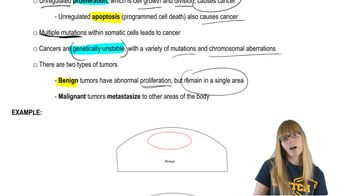
Cancer cells often have defective DNA repair and checkpoint pathways, allowing mutations to accumulate unchecked. They may evade apoptosis and continue dividing despite genetic damage, leading to uncontrolled growth and tumor development.
Recommended video:
Guided course
Cancer Characteristics
Watch next
Master Cancer Characteristics with a bite sized video explanation from Kylia
Start learningRelated Videos
Related Practice
Textbook Question
524
views
