Genomic sequencing has opened the door to numerous studies that help us understand the evolutionary forces shaping the genetic makeup of organisms. Using databases containing the sequences of 25 genomes, scientists examined the relationship between GC content and global amino acid composition [Kreil, D. P., and Ouzounis, C. A. (2001) Nucl. Acids Res. 29:1608–1615]. They found that it is possible to identify thermophilic species on the basis of their amino acid composition alone, which suggests that evolution in a hot environment selects for a certain whole organism amino acid composition. In what way might evolution in extreme environments influence genome and amino acid composition? How might evolution in extreme environments influence the interpretation of genome sequence data?
Table of contents
- 1. Introduction to Genetics51m
- 2. Mendel's Laws of Inheritance3h 37m
- 3. Extensions to Mendelian Inheritance2h 41m
- 4. Genetic Mapping and Linkage2h 28m
- 5. Genetics of Bacteria and Viruses1h 21m
- 6. Chromosomal Variation1h 48m
- 7. DNA and Chromosome Structure56m
- 8. DNA Replication1h 10m
- 9. Mitosis and Meiosis1h 34m
- 10. Transcription1h 0m
- 11. Translation58m
- 12. Gene Regulation in Prokaryotes1h 19m
- 13. Gene Regulation in Eukaryotes44m
- 14. Genetic Control of Development44m
- 15. Genomes and Genomics1h 50m
- 16. Transposable Elements47m
- 17. Mutation, Repair, and Recombination1h 6m
- 18. Molecular Genetic Tools19m
- 19. Cancer Genetics29m
- 20. Quantitative Genetics1h 26m
- 21. Population Genetics50m
- 22. Evolutionary Genetics29m
15. Genomes and Genomics
Proteomics
Problem 7
Textbook Question
How do high-throughput techniques such as computer-automated, next-generation sequencing, and mass spectrometry facilitate research in genomics and proteomics? Explain.
Verified step by step guidance1
Understand that high-throughput techniques allow researchers to analyze large volumes of genetic or protein data quickly and accurately, which is essential for genomics and proteomics studies.
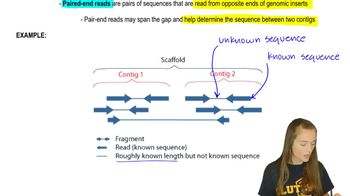
Recognize that next-generation sequencing (NGS) is a computer-automated method that sequences millions of DNA fragments simultaneously, enabling comprehensive analysis of entire genomes or targeted regions.
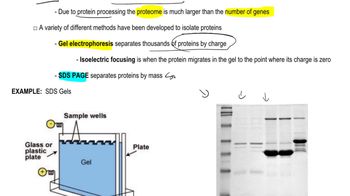
Know that mass spectrometry is a technique used in proteomics to identify and quantify proteins by measuring the mass-to-charge ratio of ionized protein fragments, allowing detailed protein characterization.
Appreciate how these technologies generate vast datasets that require computational tools and bioinformatics for data processing, interpretation, and integration, accelerating discoveries in gene function and protein interactions.
Summarize that by combining automation, speed, and precision, these high-throughput methods facilitate large-scale studies that were previously impractical, thus advancing our understanding of biological systems at the molecular level.
Verified video answer for a similar problem:This video solution was recommended by our tutors as helpful for the problem above
Video duration:
1mPlay a video:
Was this helpful?
Key Concepts
Here are the essential concepts you must grasp in order to answer the question correctly.
Next-Generation Sequencing (NGS)
NGS is a high-throughput method that rapidly sequences large amounts of DNA or RNA, enabling comprehensive analysis of genomes and transcriptomes. It allows researchers to identify genetic variations, gene expression patterns, and mutations with high accuracy and speed, revolutionizing genomics research.
Recommended video:
Guided course
Sequencing Difficulties
Mass Spectrometry in Proteomics
Mass spectrometry is a technique used to identify and quantify proteins by measuring the mass-to-charge ratio of ionized peptides. It enables detailed analysis of protein composition, post-translational modifications, and interactions, which is essential for understanding cellular functions and protein networks.
Recommended video:
Guided course
Proteomics
High-Throughput Automation and Data Analysis
Automated high-throughput technologies integrate robotics and computational tools to process and analyze vast biological data efficiently. This automation accelerates experiments, reduces errors, and facilitates large-scale studies in genomics and proteomics by enabling rapid data generation and interpretation.
Recommended video:
Guided course
Step 2
Related Videos
Related Practice
Textbook Question
495
views