You have identified a 0.80-kb cDNA clone that contains the entire coding sequence of the Arabidopsis gene CRABS CLAW. In the construction of the cDNA library, linkers with EcoRI sites were added to each end of the cDNA, and the cDNA was inserted into the EcoRI site of the MCS of the vector shown in the accompanying figure. You perform digests on the CRABS CLAW cDNA clone with restriction enzymes and obtain the following results. Can you determine the orientation of the cDNA clone with respect to the restriction enzyme sites in the vector? The restriction enzyme sites listed in the dark blue region are found only in the MCS of the vector.
Table of contents
- 1. Introduction to Genetics51m
- 2. Mendel's Laws of Inheritance3h 37m
- 3. Extensions to Mendelian Inheritance2h 41m
- 4. Genetic Mapping and Linkage2h 28m
- 5. Genetics of Bacteria and Viruses1h 21m
- 6. Chromosomal Variation1h 48m
- 7. DNA and Chromosome Structure56m
- 8. DNA Replication1h 10m
- 9. Mitosis and Meiosis1h 34m
- 10. Transcription1h 0m
- 11. Translation58m
- 12. Gene Regulation in Prokaryotes1h 19m
- 13. Gene Regulation in Eukaryotes44m
- 14. Genetic Control of Development44m
- 15. Genomes and Genomics1h 50m
- 16. Transposable Elements47m
- 17. Mutation, Repair, and Recombination1h 6m
- 18. Molecular Genetic Tools19m
- 19. Cancer Genetics29m
- 20. Quantitative Genetics1h 26m
- 21. Population Genetics50m
- 22. Evolutionary Genetics29m
18. Molecular Genetic Tools
Genetic Cloning
Problem 22
Textbook Question
How is fluorescent in situ hybridization (FISH) used to produce a spectral karyotype?
Verified step by step guidance1
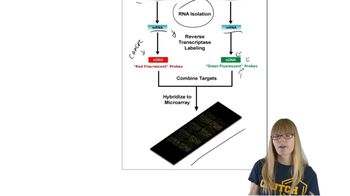
Understand that fluorescent in situ hybridization (FISH) is a technique that uses fluorescently labeled DNA probes to bind to specific sequences on chromosomes, allowing visualization under a fluorescence microscope.
Recognize that in spectral karyotyping (SKY), multiple different DNA probes, each labeled with a unique combination of fluorescent dyes, are used simultaneously to paint each chromosome in a distinct color.
Prepare metaphase chromosome spreads from cells and apply the mixture of fluorescent probes so that each chromosome hybridizes with its specific probe set.
Use a specialized fluorescence microscope equipped with spectral imaging capabilities to capture the emission spectra from each chromosome, allowing the differentiation of all chromosomes based on their unique fluorescent signatures.
Combine the spectral data to generate a full-color karyotype image where each chromosome pair is distinctly colored, facilitating the identification of chromosomal abnormalities and rearrangements.
Verified video answer for a similar problem:This video solution was recommended by our tutors as helpful for the problem above
Video duration:
34sPlay a video:
Was this helpful?
Key Concepts
Here are the essential concepts you must grasp in order to answer the question correctly.
Fluorescent In Situ Hybridization (FISH)
FISH is a molecular technique that uses fluorescently labeled DNA probes to bind specific chromosome regions in fixed cells. This allows visualization of genetic material under a fluorescence microscope, enabling detection of chromosomal abnormalities or specific DNA sequences.
Recommended video:
Guided course
Functional Genomics
Spectral Karyotyping (SKY)
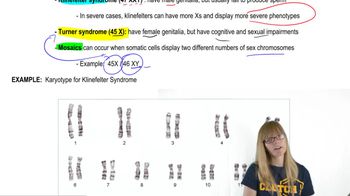
Spectral karyotyping is a cytogenetic method that uses multiple fluorescent probes, each specific to different chromosomes, to produce a color-coded image of the entire chromosome set. This technique helps identify chromosomal rearrangements and abnormalities by assigning unique spectral signatures to each chromosome.
Recommended video:
Guided course
Human Sex Chromosomes
Chromosome Identification and Analysis
Chromosome identification involves distinguishing individual chromosomes based on size, banding patterns, or fluorescent signals. In spectral karyotyping, the combined fluorescent signals from FISH probes allow precise identification and analysis of chromosomal structure and abnormalities in a single assay.
Recommended video:
Guided course
Chi Square Analysis
Related Videos
Related Practice
Textbook Question
857
views
